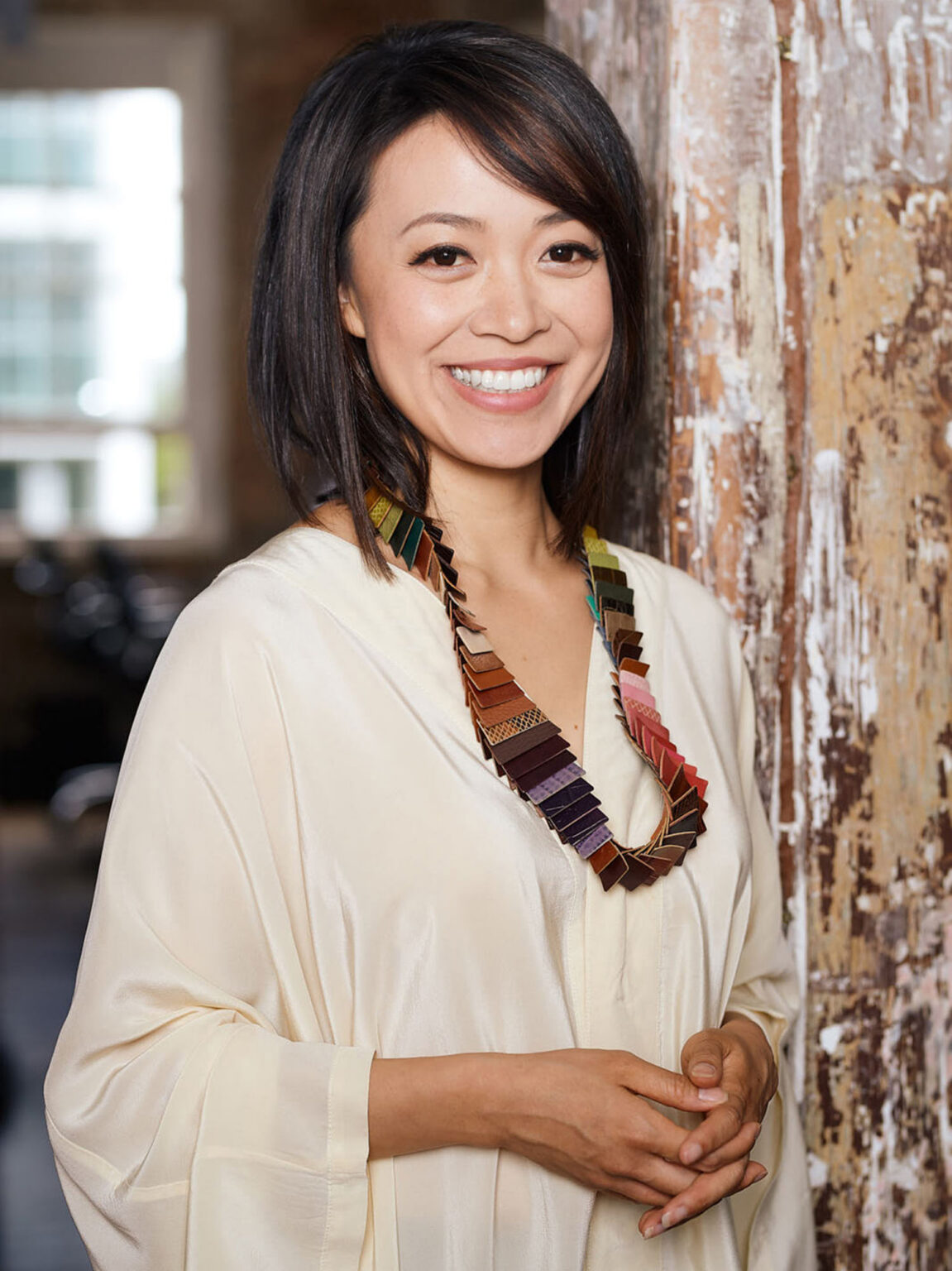
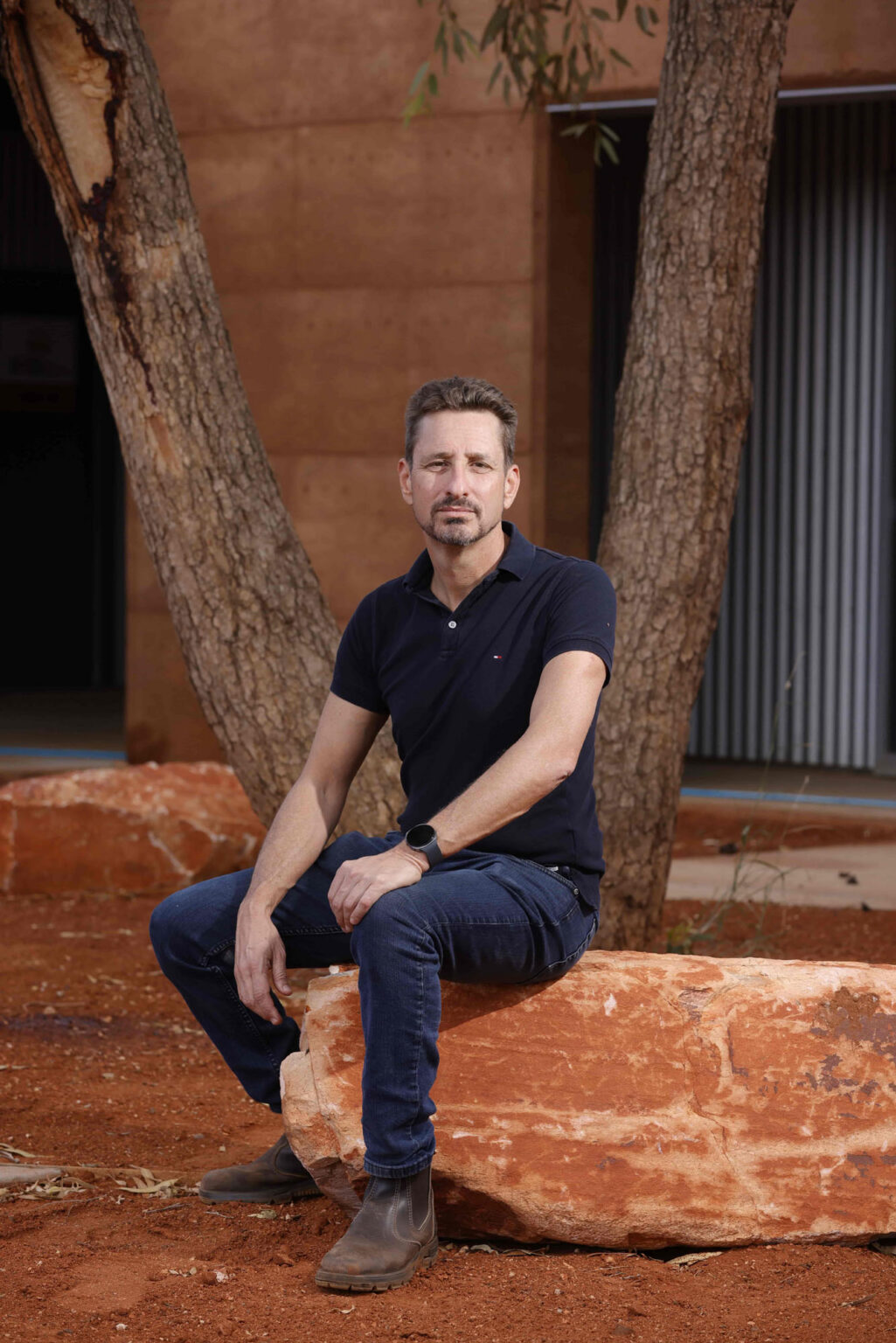
David Kaunitz and Ka Wai Yeung founded Kaunitz Yeung Architecture, the husband-and-wife practice based in Redfern, Sydney, to bring high-quality architecture to some of the most disadvantaged communities in Australia and the Pacific.
Between them they have worked in more than 40 Indigenous communities in Australia and in the Solomon Islands, Vanuatu, the Cook Islands and Papua New Guinea, producing clinics, aged care, cultural centres and community buildings shaped through long consultation and, where possible, built by the communities themselves.
The practice is perhaps best known for its rammed earth: the Puntukurnu Aboriginal Medical Service Healthcare Hub in Newman, in the Pilbara, built from the earth of its own site, and the BAAKA Cultural Centre in Wilcannia on Barkandji Country. Its work has received the NSW Australian Institute of Architects Reconciliation Prize, the inaugural ArchitectureAU Award for Social Impact and the UIA Vassilis Sgoutas Prize for Implemented Architecture Serving the Underprivileged.
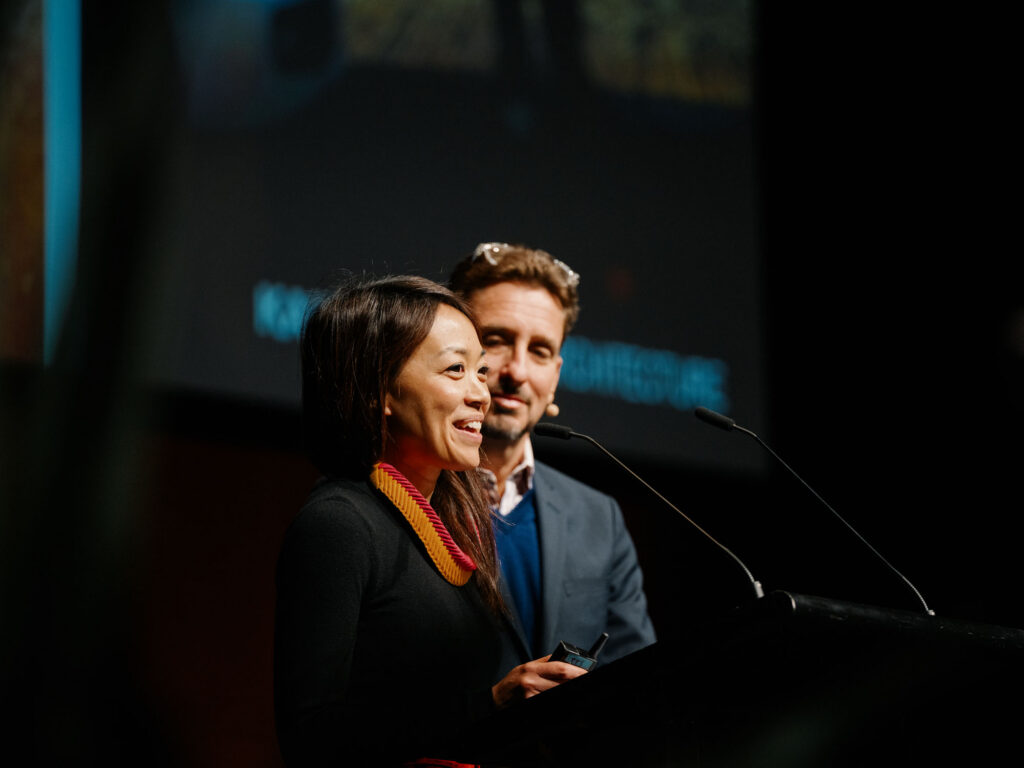
David is the grandson of Holocaust survivors and the first in his family born in Australia; Ka Wai is the daughter of migrants. At in:situ 2026, the couple spoke about early childhoods spent translating for their elders, carrying an ancestral tongue, and the world view bound up in it, into the language of a new land. They partly credit that experience with their ability to listen to clients whose cultural backgrounds differ vastly from their own. We sat down with the couple to discuss working in remote areas, developing an architectural language that caters to both skilled and non-professional builders, the importance of mass in hot climates, and more.
Federico Monsalve: You’ve always described your practice as working with, rather than for, the communities you build with. What practical advice would you give a firm coming into a community it doesn’t belong to?
David Kaunitz (DK): Humility. Not to assume you know anything. There’s the story I told about going to Wilcannia for the first time. We’d done many projects, and people warned us about how rough that place was and how uninviting it was, and we found an amazing community.
The reason why Ka Wai and I introduced ourselves and our heritage [at the in:situ speech] is also because we find it important that we leave our lens at the door, which is an expression I use quite a lot. We have our own cultural and lived experience lens. When we’re going to work with other people, with the community, it’s important to leave that at the door and start to try and have empathy and walk in their shoes.
And then listening. People say that a lot, but doing it is [another thing]. It’s not only listening; it’s listening and hearing, whatever the nuances between those two. It’s really listening and understanding, and inquiring about what’s being said to you. Not just listening and receiving, but actually inquiring, so that you have a level of understanding of what you’re being told.
Ka Wai Yeung (KWY): Advice always sounds like a heavy word. But yes, it’s really about listening and leaving any assumptions aside. The other thing is that often there will be some preconceived ideas of what a project should be or should look like. We should still do our homework about understanding the background of the project and of the site, but really keep an open mind when we actually meet people.
FM: How do those first meetings evolve? Is there a set consultation process you follow, or a set of steps to turn what you hear into a space people can inhabit?
DK: No. There’s no steps. There’s no Post-it notes. No diagrams. There’s no preconceived idea. We’ve done this a long time, so we have a whole lot of tactics. The first tactic is to meet everyone and ask how they would like to engage, and begin by pulling threads within the community to see where that goes.
We also have tactics for making sure all voices are heard, because often you hear the most confident or the loudest, whereas it’s important to hear all voices, because you don’t want to hear that quiet but important voice after the project’s finished. You definitely want to hear that dissenting or that other perspective beforehand.
FM: Some of your projects have long gestation periods between consultation and delivery. How do you keep everyone engaged over that time?
KWY: In an ideal world, we would like not to have that pause. But circumstances change. For example, when COVID happened, some of our projects [faced] more challenges in implementation. The key is just to keep communicating with the community and keep going there.
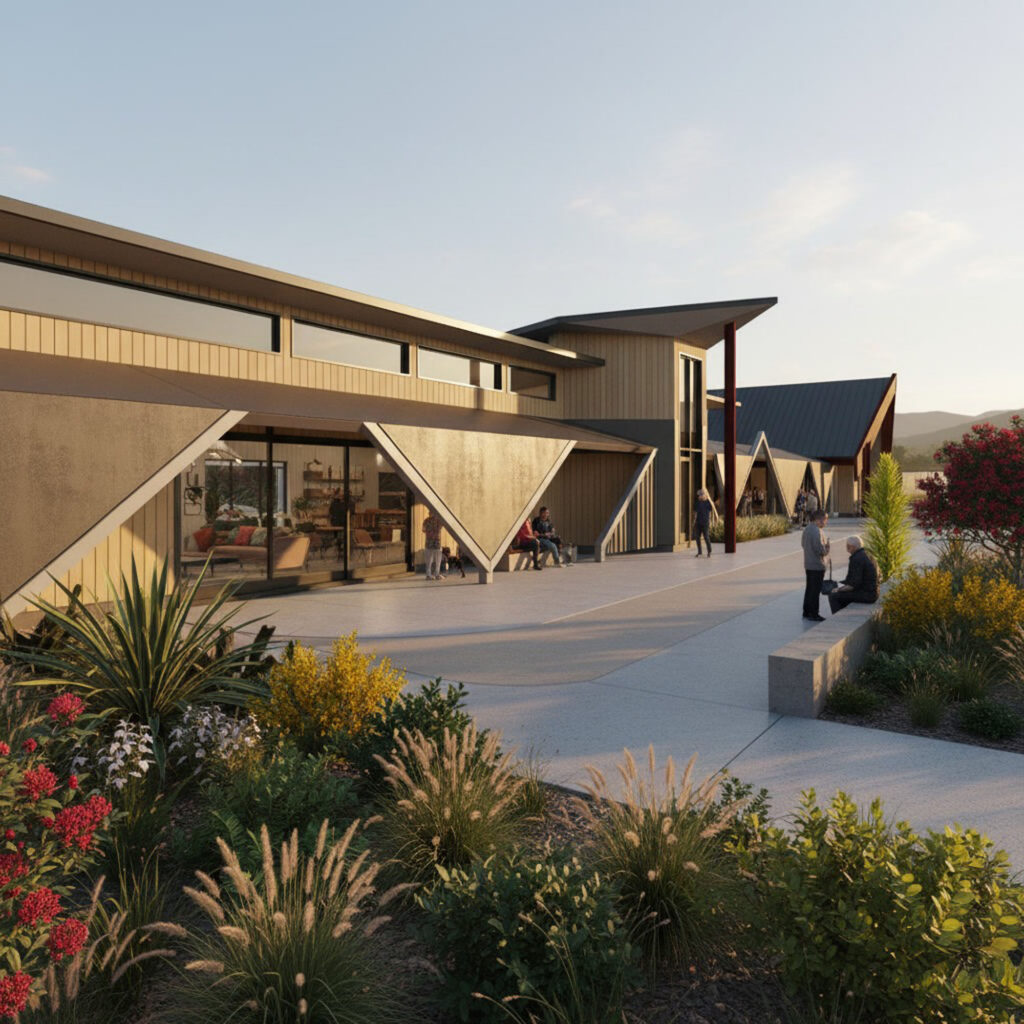
Sometimes you can turn what seems to be a challenging situation to your advantage. For example, [with] the Yutjuwaḻa Djiwarr Aged Care project in Nhulunbuy, our consultation process got stretched out because we had to wait for the lease. That wait actually allowed us to have an even more comprehensive and thorough consultation with the community.
DK: You need to stay engaged. At Wilcannia, there was a gap because the project got delayed by COVID, so we decided to start running the architecture studio there, taking the students there. We just made the most of that. And then we have all sorts of processes to keep them engaged during construction. The art screens, for instance, are usually only done during construction. The landscape design is usually only done during construction. That way you have enough excuses to interact with everyone and keep things going.
FM: You often bring the community into the construction itself. Why do it, what does it bring to a project, and how is it managed?
DK: Well, it’s not like managing a commercial builder. At least their heart’s in the right place.
Overseas in the Pacific, it’s a pretty easy affair, because we’re working in communities that are used to building. They’re very skilled. In the Solomon Islands, for instance, they’re very skilled carpenters. In the Cook Islands, they make their own concrete blocks and know how to lay them. So in those cases there are people ready and wanting to work. And it’s not always volunteer. In the beginning, 20 years ago, it was volunteer. Now you struggle to get these projects [done] at a volunteer level; everyone needs to be paid. The world has just moved on. Money is imperative, even in the most remote communities.
In Australia, it’s harder because of the regulations. But when the community’s up for it, like the project we’ve got going now, the new Mimal [Rangers Base], then it’s great. With community builders, [you] take a more step-by-step approach. Time is less of the essence; it’s more about participation. So naturally, they did the foundations and they stopped, and then they did the rammed earth and they stopped. Next will come the roof structure. Whereas with a commercial build, everything’s happening as quickly as possible and overlapping. So in a sense it’s less difficult to do, because it’s more sequential. And they care more.
FM: You work in some extremely remote places, with limited access to materials and the right workforce. How do you deal with that scarcity?
DK: It’s different in the Pacific [compared with] Australia. In the Pacific, we tap into local supply chains: local timber, local gravel and sand to make our own concrete blocks, whatever it is. You’re constantly working out what the supply chain is. Some things are imported, but there’s a lot of local material. In Australia, remote communities don’t make any material. There’s no manufacturing. Well, there’s one community that makes precast concrete…
KWY: Concrete blocks.
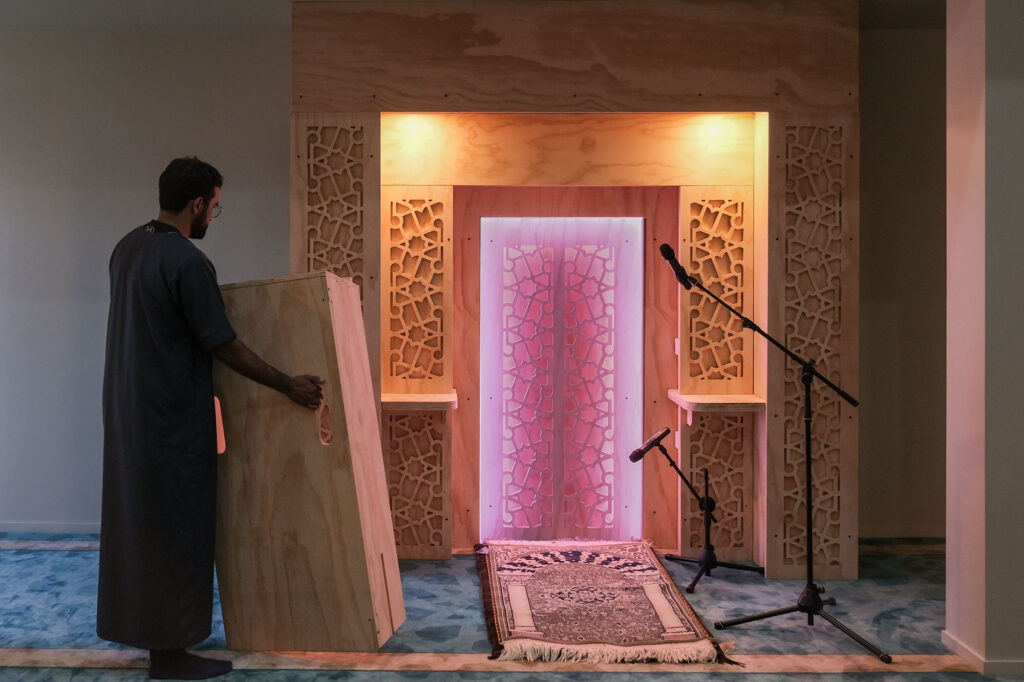
DK: Concrete blocks, yes. And timber milling in the North West. There are a few instances, maybe three in the entire 50 communities we’ve worked in. That’s one reason why rammed earth is so seductive to us, and why rammed earth has been so successful. Clients want it. They understand it. It makes sense financially. It’s cheaper. It’s probably the only circumstance where rammed earth is cheaper in Australia. It’s probably about the same price as Colorbond, but if you bring in the Colorbond, you’ve got to have someone install it; it’s a whole process. Whereas the people who build rammed earth are used to working in these kinds of places. They bring their caravan and they get stuck in. Rammed earth has definitely been a game changer, I would say, and [has] simplified the build.
KWY: And most importantly, we work with Indigenous communities. In terms of connecting with and designing [for] Country, building with earth, building with something that is part of Country, has a very significant meaning to them. That is definitely a big reason why. We waited 10 years to actually manage to get a rammed earth building done, and after that, a lot of clients wanted [one].
FM: And they’re quite beautiful. There’s the tactility of it; it’s a humane material.
DK: Right. People feel that. But to answer your question a bit more fully, because it’s a very good question that gets to the crux of what we do: you also have to design buildings that can absorb pretty shitty detailing and poor construction. That’s why you see a lot of monolithic buildings, and a lot of very simple, strong, articulated forms, because the fine grain is not going to be there, and the multiple trades and how it all joins together is not going to be there. The architectural language has developed in a way that can absorb that lack of skill and lack of materials.
The other thing is that pretty much everything we’re doing remotely in Australia is now prefabricated. It’s gotten so complicated and so expensive to build in Australia. There’s such a skill shortage. Finding a carpenter or a plumber who is willing to go is getting harder and harder, because there’s so much work in town.
Traditionally, prefabrication costs the same. It’s probably a little bit cheaper right now, because mobilising the site is so expensive because of fuel. But the quality is so much better. Prefabrication gives a big opportunity to improve the quality of what’s going on.
FM: The UN has said that exceeding the 1.5°C climate threshold is now inevitable, and architects aren’t used to designing for higher temperatures. What lessons from the Australian outback could be applied elsewhere?
DK: Mass. My simple answer is mass. I’m becoming a mass zealot. Shaded mass is the way to deal with these huge temperatures, even in tropical places. Most people we talk to have been quite dismissive of our idea of using mass in tropical environments. It’s probably not so foreign in Southeast Asia, South India and South America. But if you go to tropical parts of Australia, people think you’re mad if you’re building with mass.
We’ve done a lot of modelling with people who actually know this kind of stuff: materials experts and building systems experts. The key is if you shade the mass. In a tropical place, the temperature is generally 30 degrees all year round, and that’s going to increase, but it’s got a range. What’s making it hot is the humidity, not necessarily the ambient temperature. I think the mass provides the strength to deal with that. And certainly in the desert, you feel that buildings are going to need to be thicker and thicker.
KWY: And in most of the projects we work on, we are blessed with solar. Having renewable energy not only means recurrent carbon emissions are reduced dramatically, but it also means the recurrent funding for the facilities is reduced as well. That’s another thing we always look at. Even when funding becomes challenging, there’s always a bucket of contingency, and if towards the end of the project we can add more solar, we will add more.
DK: The rammed earth building in Newman pretty much runs off grid, if only they’d turn the air conditioning off at night. You can’t quite control client behaviour perfectly, but it effectively runs off grid. It’s got rammed earth walls, and you need air conditioning because it gets to 50 degrees in summer and it’s a clinical building. So the air conditioning is using 100 per cent renewable energy, apart from when they don’t turn it off at night. And the building could be better insulated if the rammed earth were even thicker. The only place where it’s still failing is the gases in the air conditioning units, but they’re getting better, and they will get a lot better.
I personally think the obsession with insulation and layering buildings is not the right trajectory, because the mass will provide that diurnal range. It’ll make the building solid under quite extreme climate, because it’s not only the temperature; it’s the extremity of the climate. Then, through a mixture of on-site renewables and more environmentally sustainable air conditioning systems, which will come, I think the problem is pretty [much] solved in that instance.
KWY: Especially in the projects we do in the Pacific, a lot of the materials are naturally found around the site. They are not processed. It’s basically a pre-industrialised way of building, and for us that is the ideal. If you have the time, the people, the skills and the training, then that’s the utopia. Obviously, in cities and in Australia, it’s more difficult to achieve that. But what’s always in mind is how to get as close to that ideal as possible.
FM: I was struck by the fact that you bring your children with you everywhere you go! You spend months on remote sites and your young ones are always there.
DK: Well, we have to. It’s the law. You can’t just leave them!
KWY: One thing that’s good is that we start them very young. It’s just such a part of life. Even before kids, work and life were so intertwined for us. After having kids, we still have to go to communities, so we just bring our kids along. We think a lot about parenting, and we think a lot about the kids we see in different communities and how resilient and amazing they are. We’re just so grateful that we can take our children to different communities where they can play. We’ve had stints, for example with the Nhulunbuy project, where we lived in the community for a couple of months and our kids went to the local preschool. For us, a lot of it is that we didn’t pre-design how life was going to be; we just adapt.
DK: And they seem to be adapting as well. Well, they’ve got Stockholm syndrome. But the parenting aspect is definitely something we talk about a lot. We are now deliberately putting the kids in those situations and making the most of it. It’d be very easy for one of us to travel, swap the travelling and keep the kids at home. But we make a conscious effort to plan at least a couple of trips a year during school holidays and take the kids. We live in a privileged position. Our kids grow up with more affluence than people have ever had in the history of humanity, and we’re just trying to keep them grounded and keep them regulated.
KWY: At the same time, one of the slides we showed was from the Solomons, where you see kids as young as four or five helping to carry timber while the community was rebuilding after the disaster. I feel that kids’ abilities are so constrained by their parents’ imagination. When you let kids do what they want, they are just so able and amazing. So we are conscious of trying to bring more out of our children.