Architect and academic Dr Charmaine ‘Ilaiū Talei on returning to the Tongan dwelling, the slow work of making buildings people keep loving, and why the most useful part of a brief is often delivered on the walk to the car park.
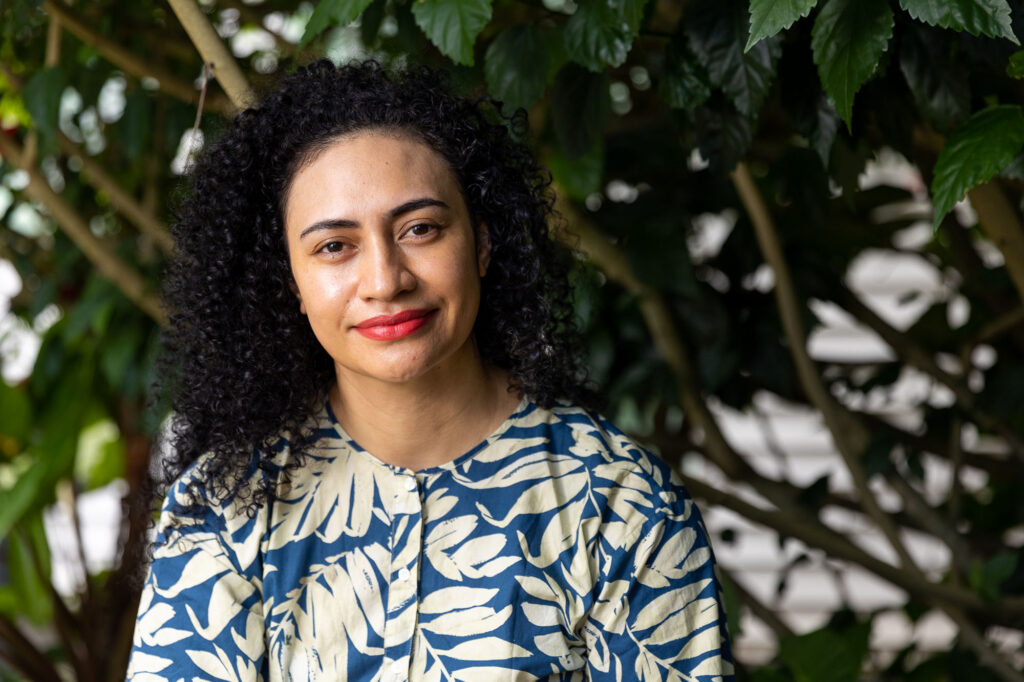
Dr Charmaine ‘Ilaiū Talei is Tongan-New Zealand architect registered in both Aotearoa and Queensland, she has practised across Tonga, Fiji, Samoa, Vanuatu, the Solomon Islands and Papua New Guinea, on projects ranging from an airport refurbishment to a correctional facility. She is also a Senior Lecturer at Te Pare School of Architecture and Planning at the University of Auckland, where she directs Fofonga, the university’s Pacific research platform.
Her research, however, has often returned to something much more modest: dwellings. Her doctoral thesis at the University of Queensland traced the transformation of the Tongan fale from thatch to concrete block, and she is currently using that knowledge back into her practice.
Speaking to Architecture Aotearoa on the sidelines of in:situ 2026, Dr Charmaine described two projects in Tonga through her own practice, both aimed at Tongans in the diaspora. The first looks at expats who want to build in their country of birth but, after years away, might no longer know how local processes and systems work.
Alongside this, her Pacific Housing Wellbeing research looks at how Tongan families apply their cultural values to state housing in New Zealand, adapting the standard suburban four-bedroom house for both ceremonial and daily life. “There is this returning to what I was always most interested in: the dwelling, and how Tongan people live within them,” she says.
One example she offers of the culturally-specific spatial needs, is the customary ‘avoidance’ between brothers and sisters, grounded in a value known as faka’apa’apa. “That’s a customary behaviour one might think would be discarded once people left Tonga, but it continues,” she says. In her own family home, the garage became a second dwelling for her brothers once they reached puberty.
She describes her practice as an agency, and means the word in more than one sense. “I’m working as an agent for the diaspora, but it’s also an agency for our industry: to role model the use of early Pacific building technologies and material ideas,” she says. The aim is to show, through built work, that the divide between modernisation and what she prefers to call sophistication, two worldviews rather than a hierarchy, can be bridged in contemporary island homes.
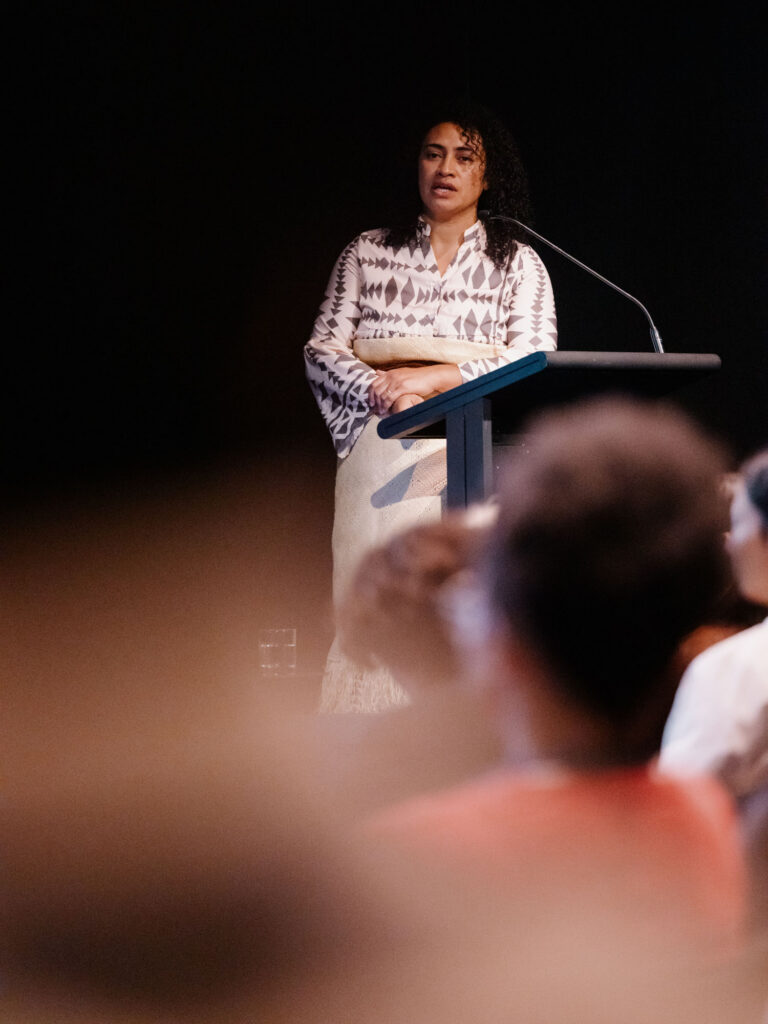
That ambition, which she also pairs with a fascination for ‘slower architecture’ which, much like its culinary equivalent, relishes provenance and quality of materials as well the traditions that continue to craft them. She agrees that this sits uneasily with a construction industry geared to speed and profit, and ‘Ilaiū Talei frames the problem in terms of endurance. Looking at classical buildings in Greece, she began to wonder why some architecture holds people’s affection across millennia. “Why do we still have crowds going to the Parthenon today? We don’t have crowds going to the SkyTower,” she says and hints at an answer that has to do with long lasting traditions deeply enmeshed with the process of designing, material selection, crafting and maintaining.
Contemporary building, in her view, has traded lasting connections to the past for hype. In the Pacific, she sees a parallel kind of timelessness in structures maintained by cultural systems, which continue to be built and cared for because communities value them. “That would be the greatest accolade, as an architect: to build something that people would just continue to love.”
Asked what connects projects as different as a correctional facility and a small fale, she does not point to a style. She points to people, and to vā, the relational space between them. Vā was not invented by academics, she notes; the Samoan writer Albert Wendt gave it theoretical form, but it describes how Pacific peoples already live, with relationships placed above almost everything else. In practice, that means extending the same care to clients, colleagues and engineers alike. “It’s about how we treat people in the process of doing architecture,” she says. Without that, the large projects she has worked on would have collapsed.
It also means listening. ‘Ilaiū Talei credits her upbringing, and years spent alongside two senior Tongan architects, rather than architecture school, with training her ‘ear’. In meetings with elders, or even seemingly random encounters or fleeing moments like an overheard song; a story that seems unrelated to the project can carry something that later shapes the design. “If you don’t really, really listen, you’ll miss it,” she says. Those who are not attuned may switch off and open their laptops. Often the story returns in another form, perhaps on the walk to the car park, for anyone who missed it the first time.
Knowledge, in her view, is plural. “There’s value in any story… that’s knowledge. It’s not just what’s in the building code.”
On regulation she is pragmatic. Many Pacific nations have no building code of their own and rely on adapted New Zealand or Australian versions, often drafted with expatriate consultants working alongside a ministry of works. The outcome, she says, depends on whoever happens to be in the room. She argues for locally led regulation, and suggests that the registration of Pacific architects might also differ, perhaps requiring several years of hands-on site work rather than time in a practice. “We’ve got to be a lot more customised and locally appropriate, because that’s the reality.”
Tonga offers a precedent: her late uncle, the government architect Siaosi Moala, was involved in drafting the country’s building code, first published in 2001. Among its provisions is a clause allowing any thatched structure under 30 square metres to be built without code compliance or an architect, acknowledging the bush kitchens and secondary dwellings that sit alongside contemporary houses. For ‘Ilaiū Talei, it is regulation that starts from how people actually live.