


Ti Point House by Crosson Architects

A house by Crosson Architects on a former Ti Point farm draws on the volcanic geology and coastal curvature of the Rodney landscape to ground itself — robustly but lightly — in a place shaped by deep geological time.

With sculpture parks, boutique wineries, a marine reserve, and cafés at every turn, this part of Rodney Ward is well-known as a playground. It combines proximity to the sea and populous bach enclaves such as Matakana, Leigh, and Ōmaha with sites of a still slightly private character, tucked down the sides of country roads.

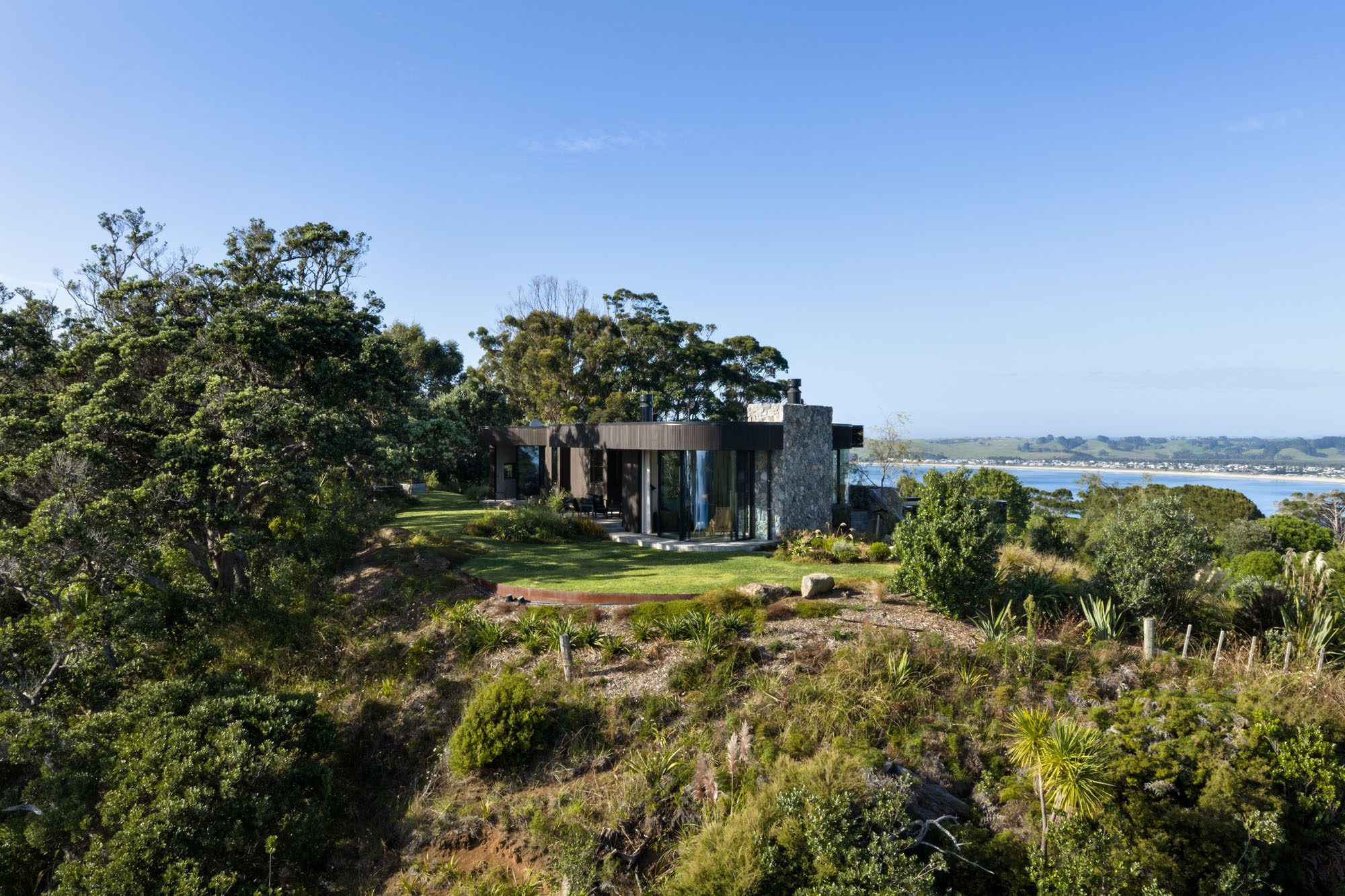
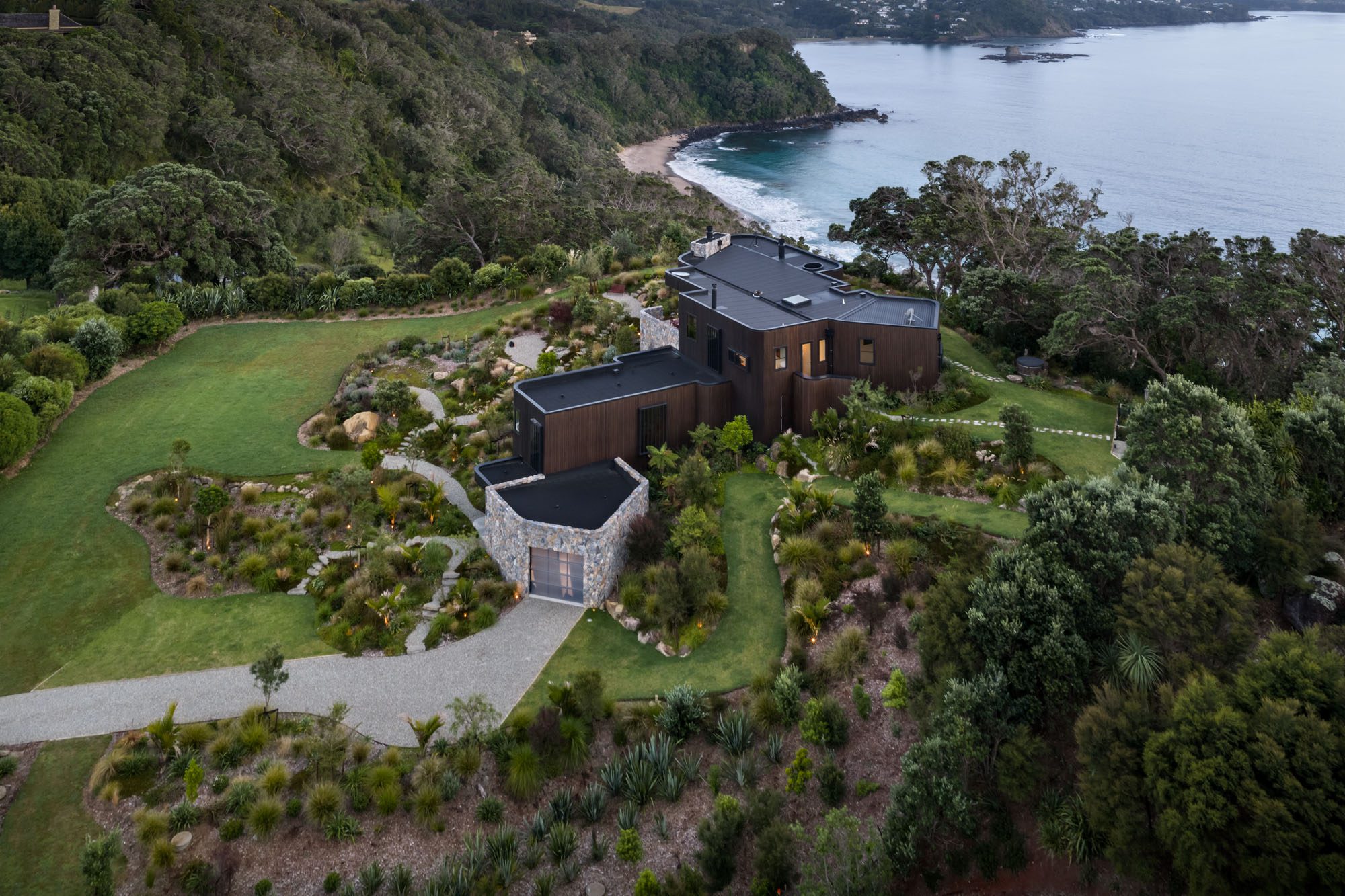
To access this particular site, former farmland, you take a long, winding driveway past mature trees to find the house perched proudly atop a steep ridge.

“It’s an epic site,” says architect Ken Crosson, noting its impressive elevation. “[The house] kind of peers over the ridge to the view at the top.”

The owners — long-standing friends of the architect, who has designed several projects for them — wanted a permanent home, where their children could come and go without the place feeling too cavernous in their absence.

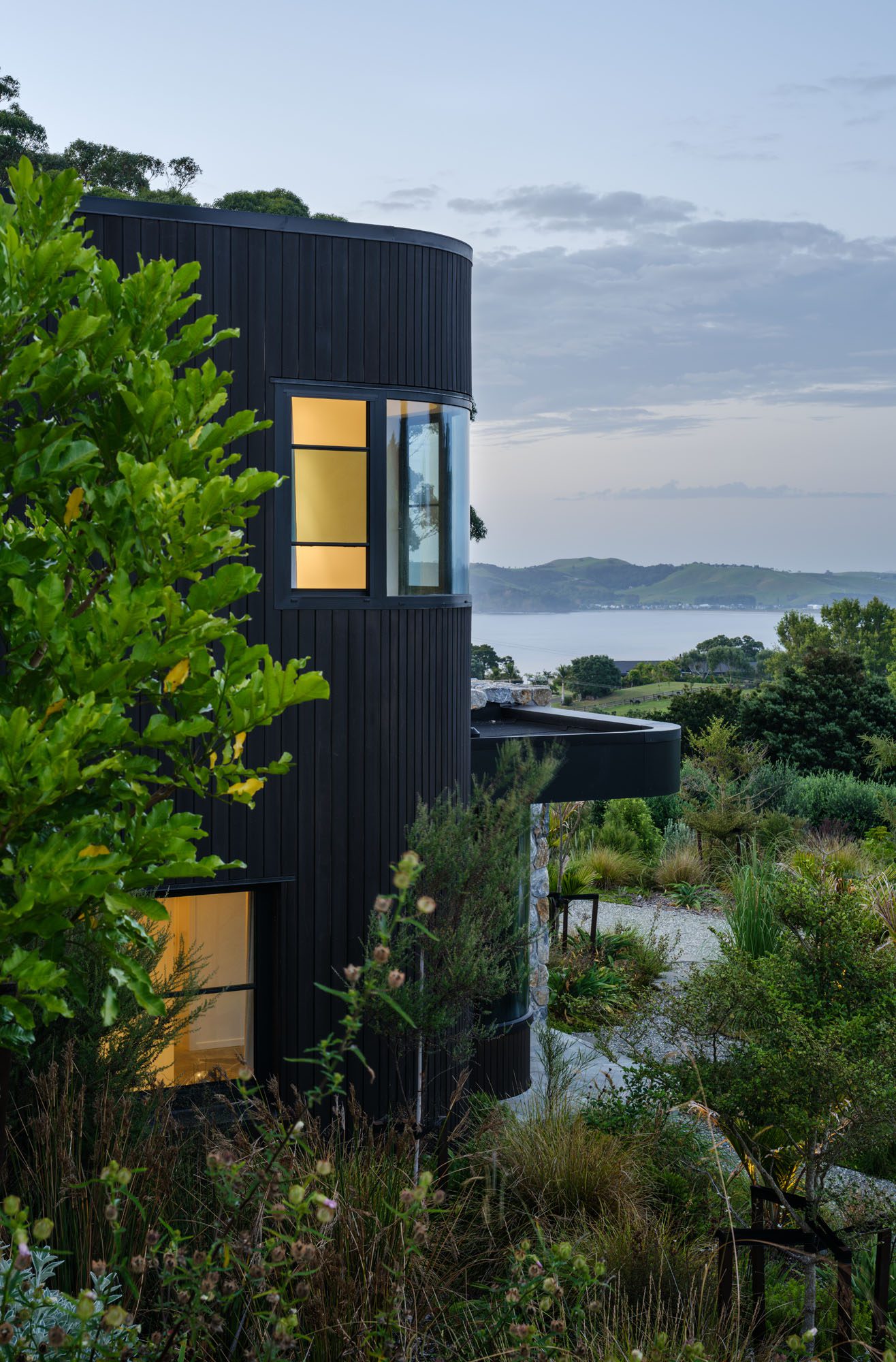
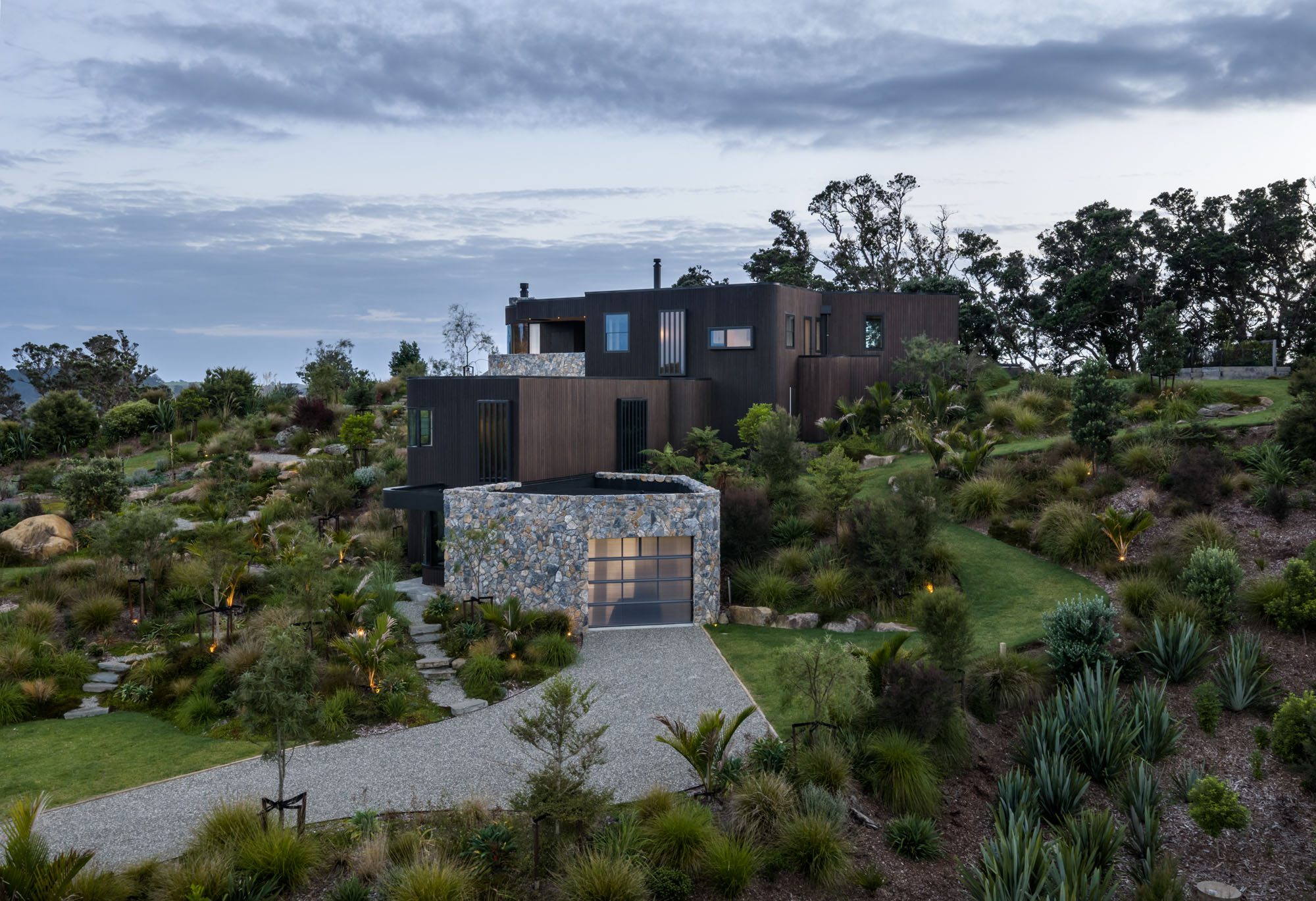
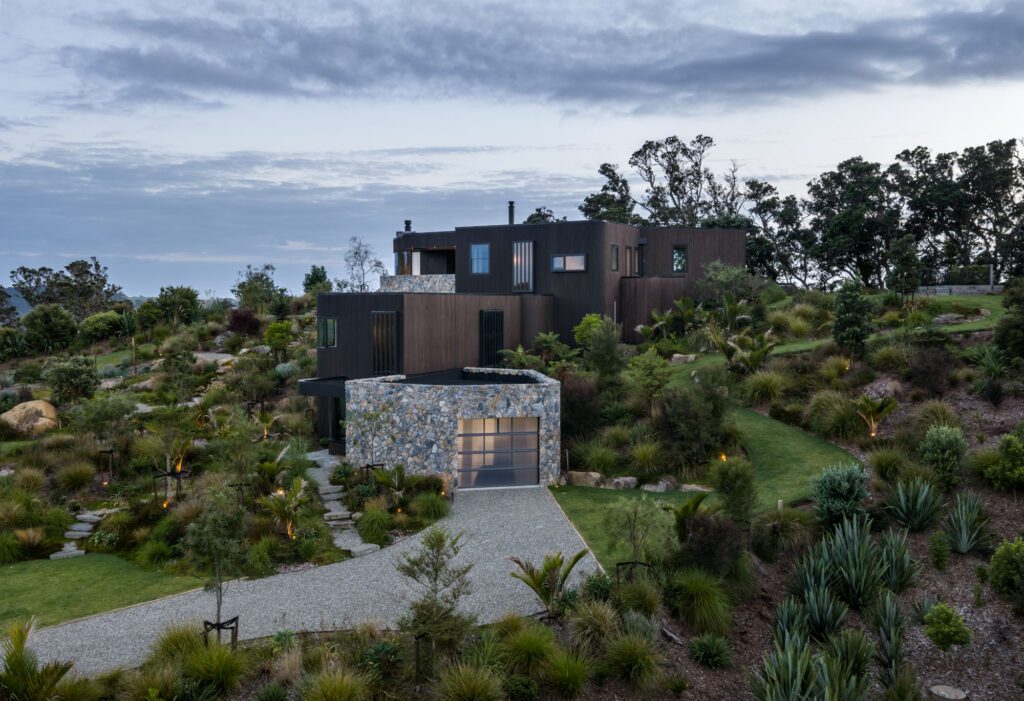
Volcanic basalt laid in a rough coursed stack transitions to vertically fixed charred cedar, the two materials together narrating the geological and coastal character of the site.
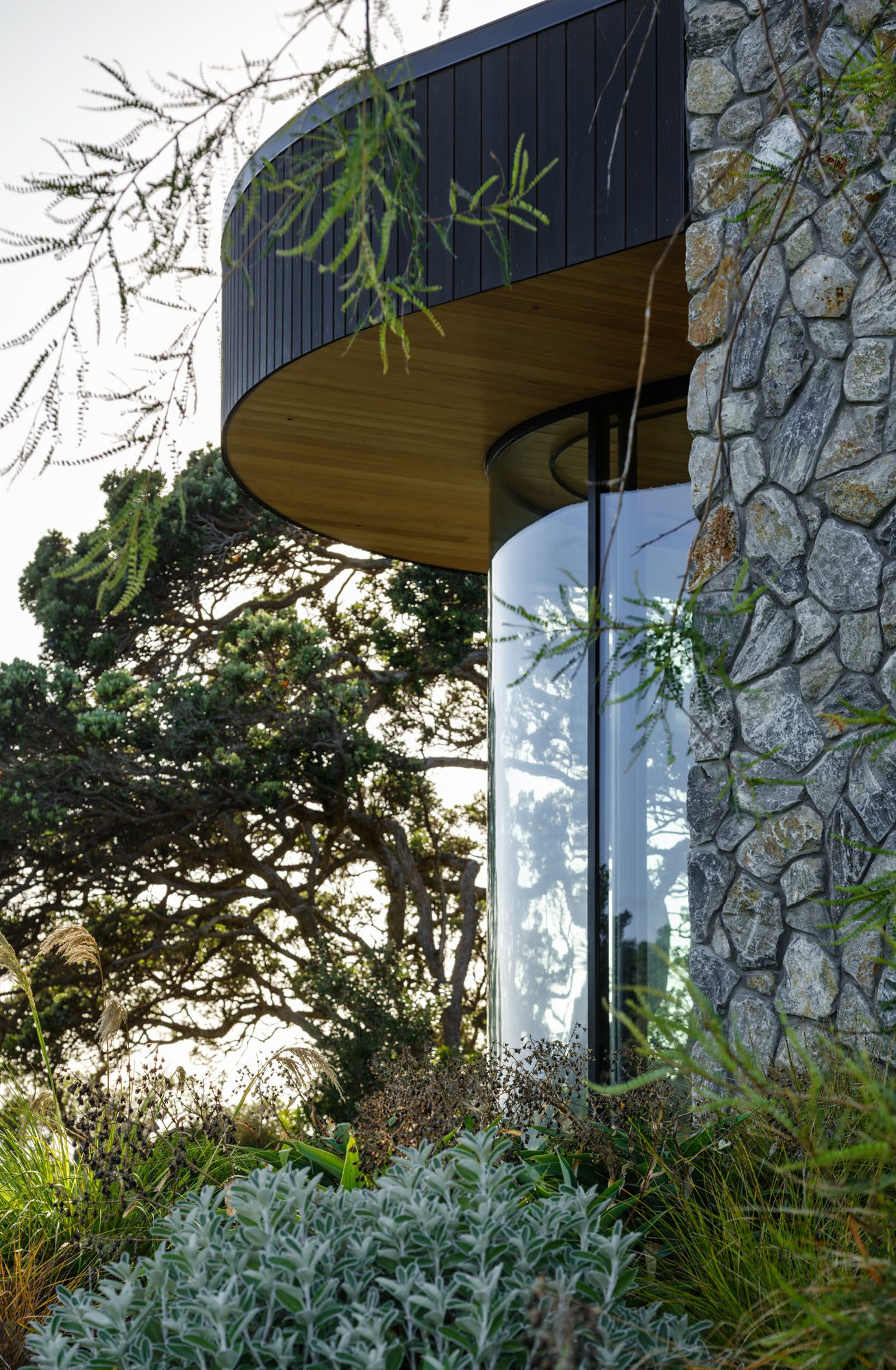
Stacked basalt walls, a material inspired by the stones found on the site, rise to meet the charred cedar above. The volcanic rock type found here is unique to the area.

“What we wanted to do was sit a house basically on the hill but not dominate it,” says Ken, who describes a certain dichotomy at the heart of the design: “quiet materially, but robust, because the site is pretty brutal as well. We wanted it grounded — Frank Lloyd [Wright] — but also with a lightness to it.”

This duality responds not just to the steepness of the site and its exposure to the elements but to a desire to emulate the soft curvature of the surrounding geography and the solidity of the region’s volcanic stonescape.

Ti Point is widely regarded as the remnant of a volcano that erupted millions of years ago. Much of the peninsula consists of deeply eroded volcanic material — including intrusive rocks such as dykes and sills — interpreted as part of the volcano’s exposed plumbing system.

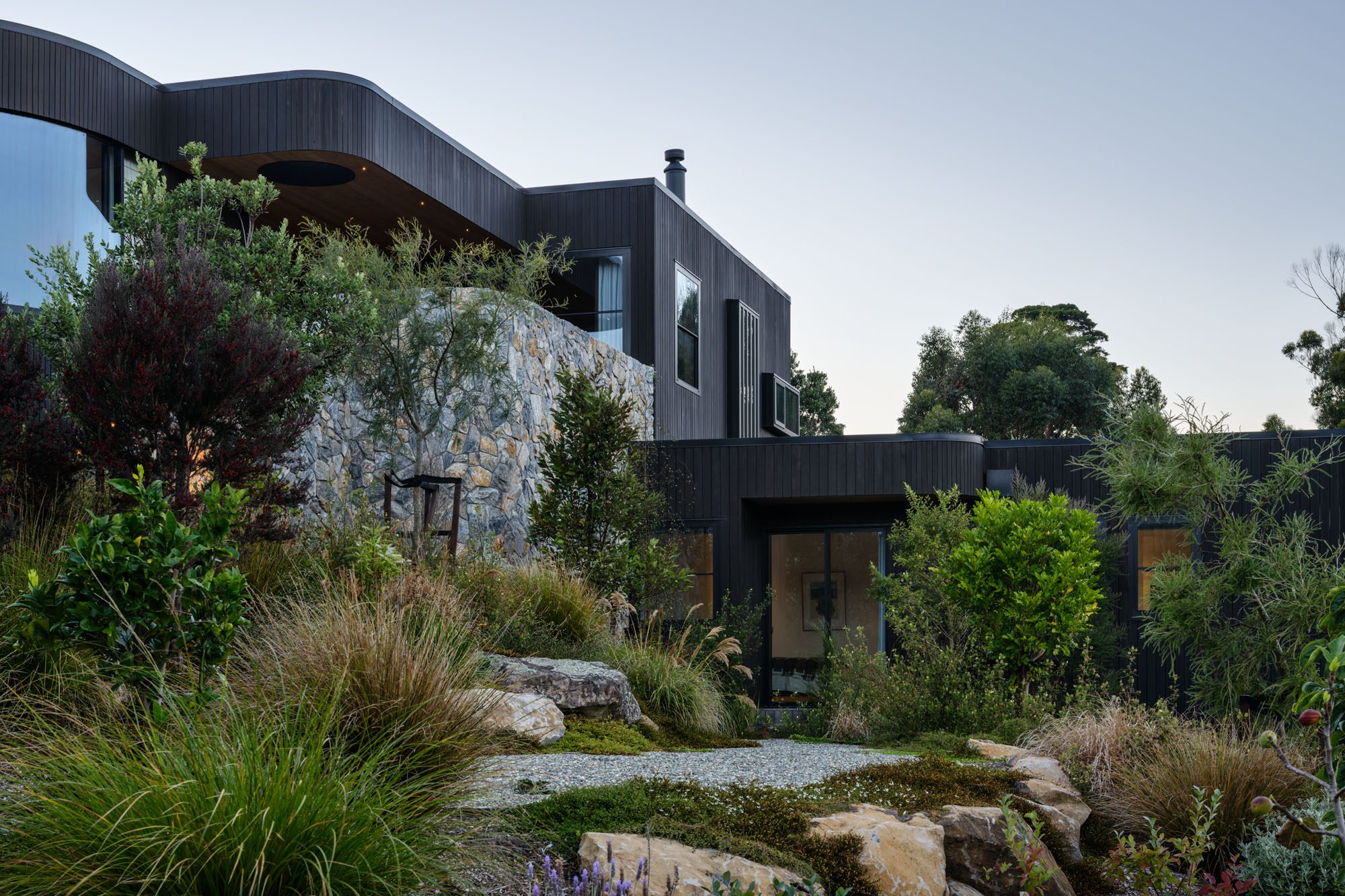
The entry side of the house, seen from the driveway approach. The stone base rises from the landscape like an extension of the ridge itself. The curved bays at either end project toward the sea, softening the building's edge. The landscape was designed by Wraight + Associates and delivered by Rochford Landscapes.

“Our understanding is that there was a volcanic eruption out there somewhere in the Hauraki Gulf,” says one of the owners, gesturing toward rocks incorporated into the landscaping. “The only stones of this geological type are found either on Ti Point or Stony Batter — they must have been a rim. Even if you go another 200 metres that way, the stones are not there.”

For the robustness of the design, Crosson Architects took some of that volcanic history and reinterpreted it through materiality. Large basalt boulders found on the site punctuate the grounds and are incorporated into low retaining walls. Stacked stone wraps around various walls of the façade and continues into the interior. This

is complemented by yellow cedar, which, fittingly for the volcanic narrative, has been charred to a dark, quiet tone that helps it recede into the coastal landscape.

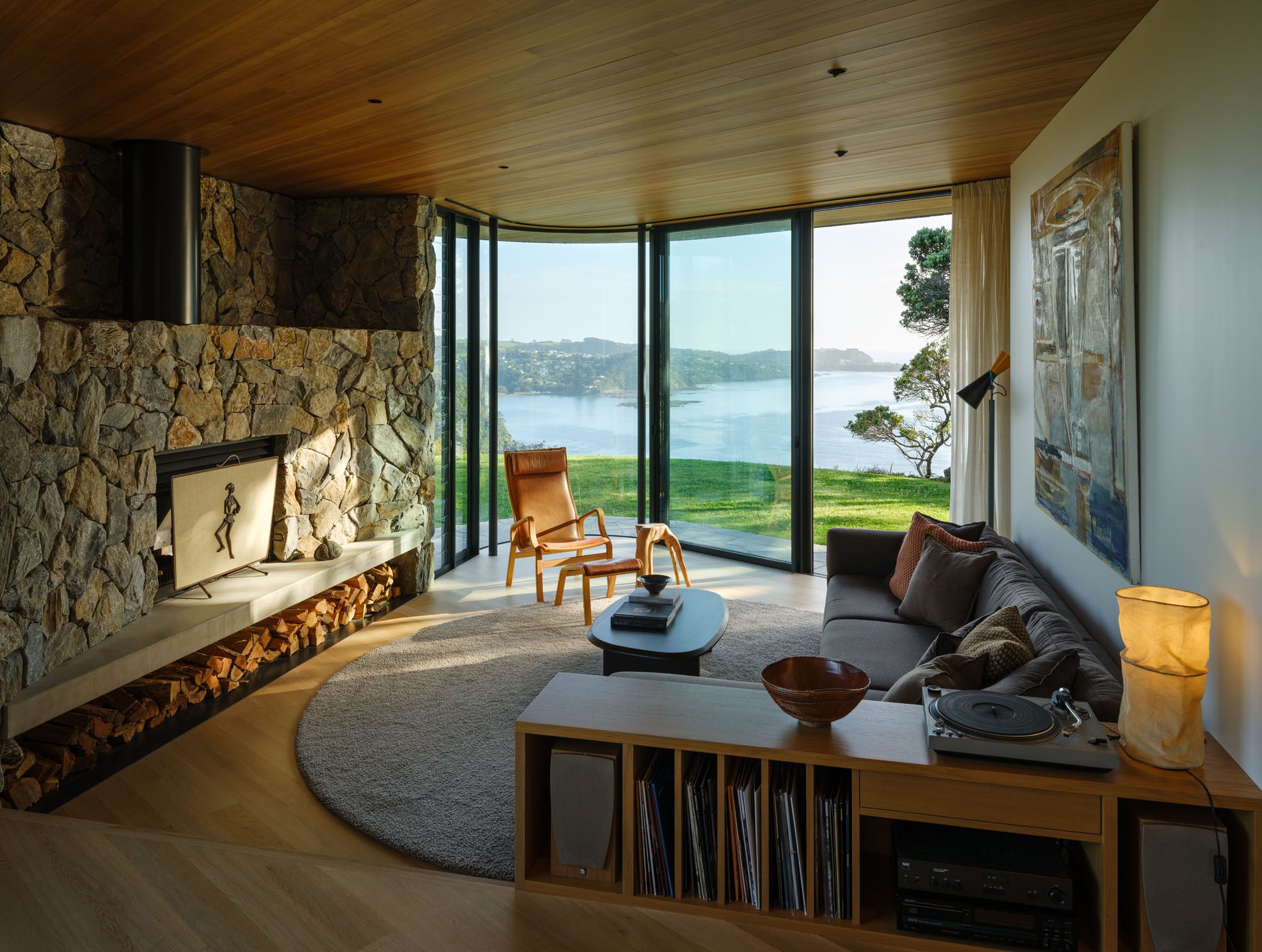
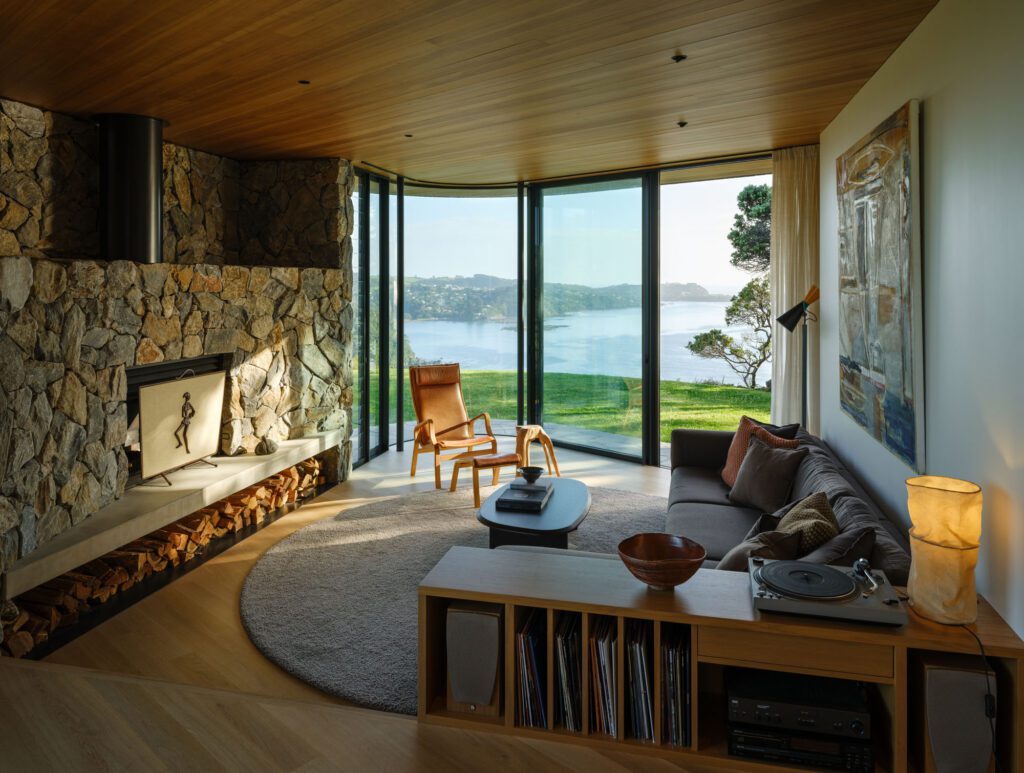
The top-level living room, where a large curved glazed bay delivers the most dramatic connection to the landscape. Stone defines the hearth; dark timbers and soft curvature lend a nostalgic warmth.

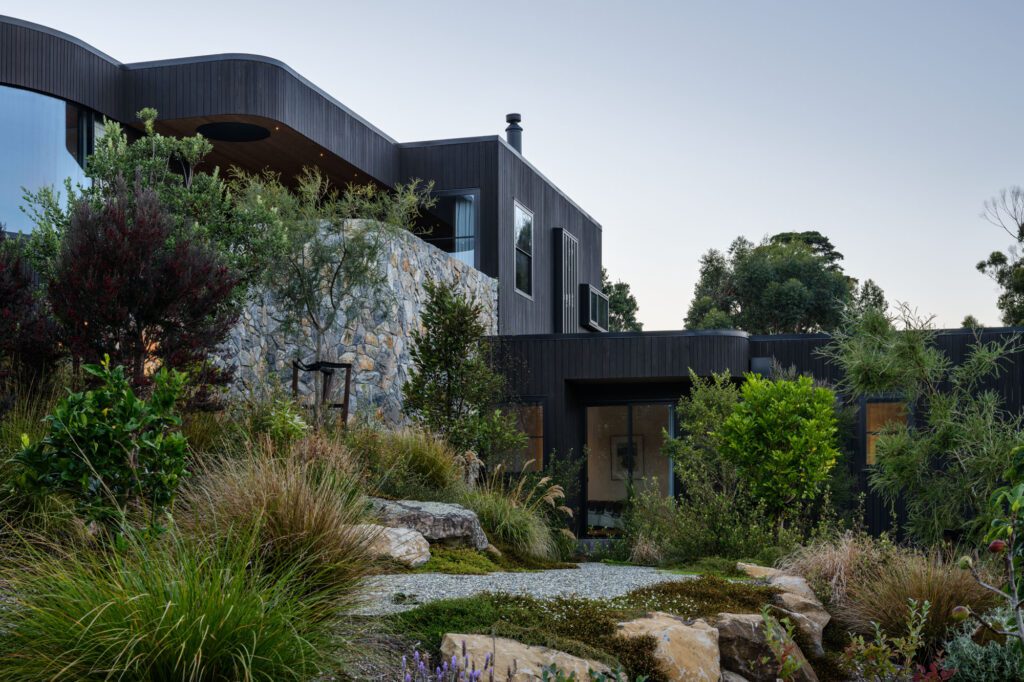
Then there is the curvature. Soft curves appear throughout the surface: at the ends of the building as it projects into the landscape, on soffits, at internal moments, and at an impressive window that follows the roundness of a wall.

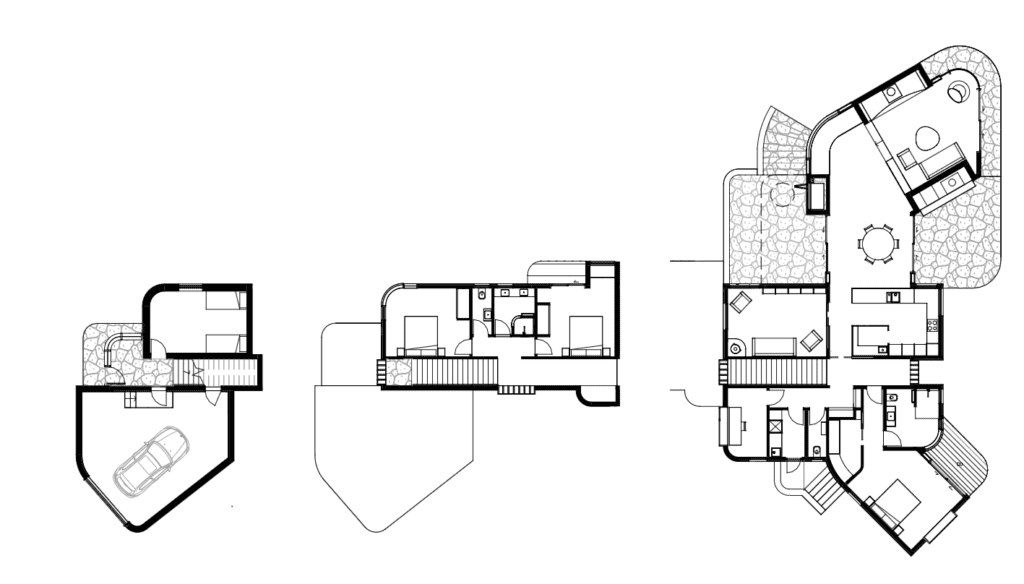
It is in the form itself, however, that this roundness is most pronounced. The plan, read from above, has the quality of architectural calligraphy — a pronounced central stem culminating in two wings that extend sideways and curve dramatically upwards. The building reads as a compact, multi-winged form: a central core with arms extending outwards at angles, each oriented to a specific view of the sea. There is something almost Japanese — almost Shodō — at play, but also something that emulates the many small bays that surround the site.

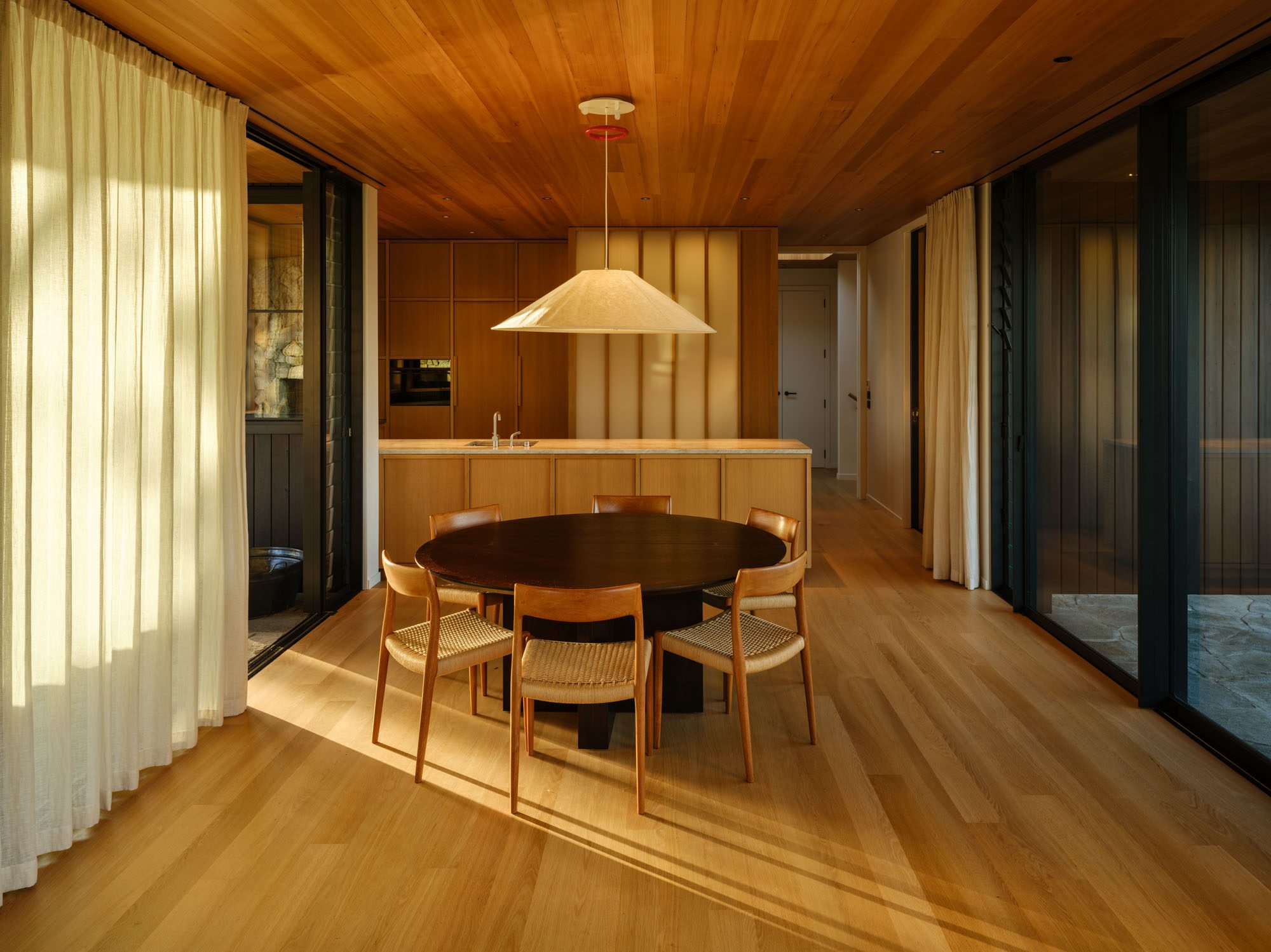
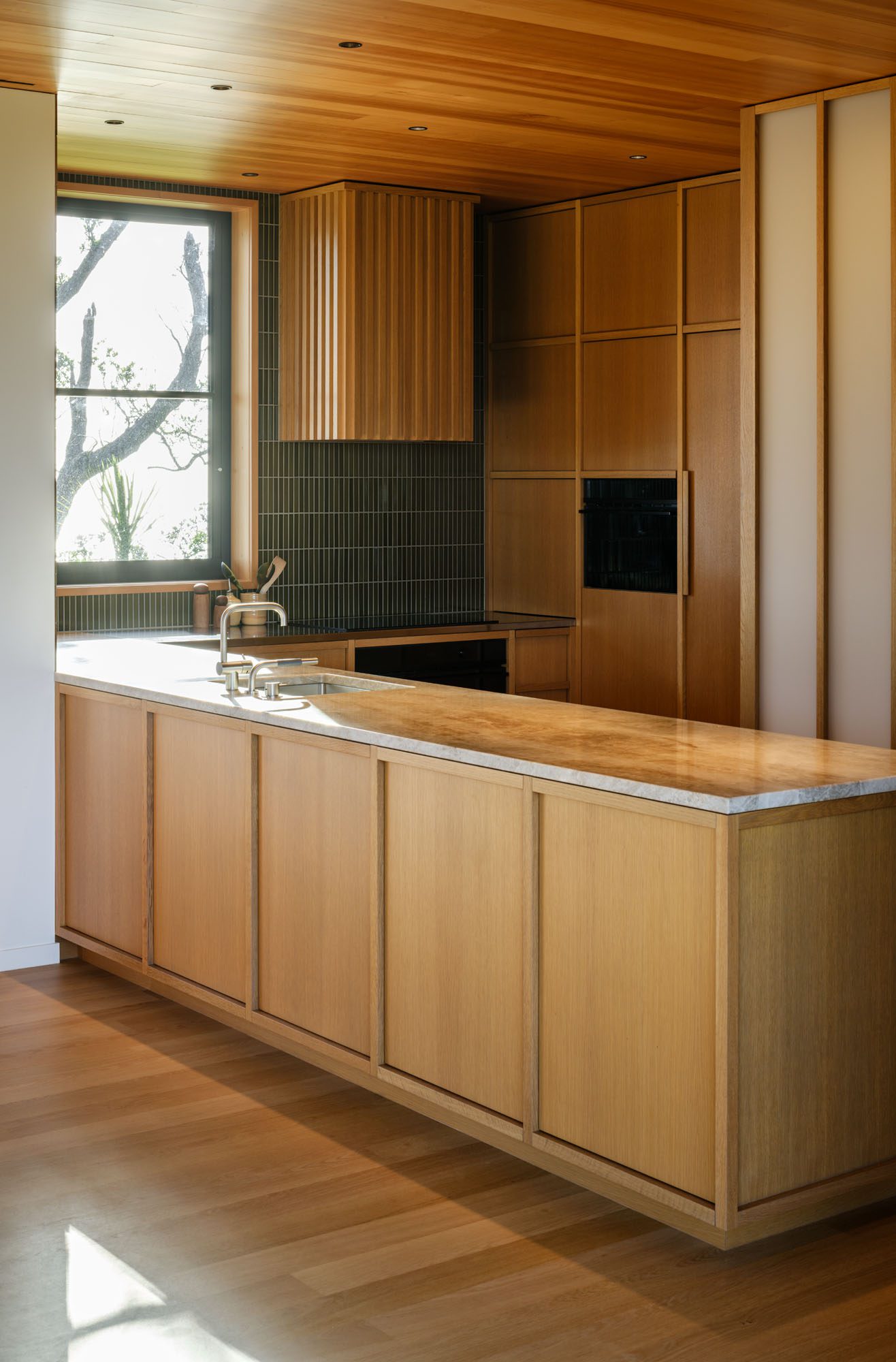
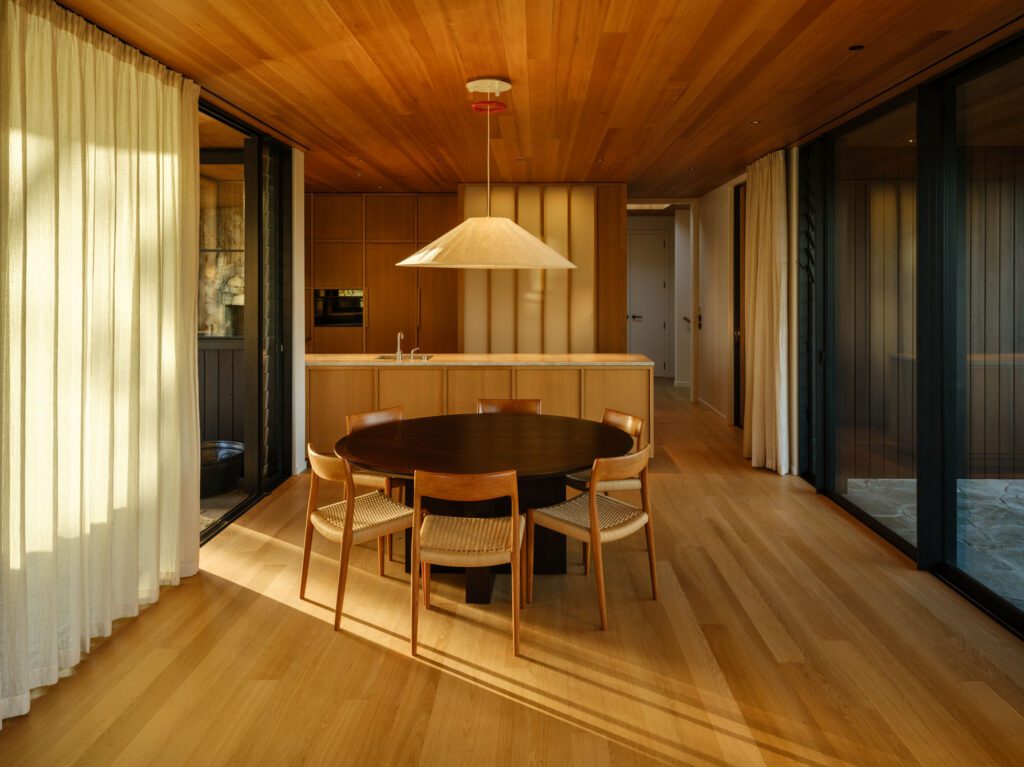
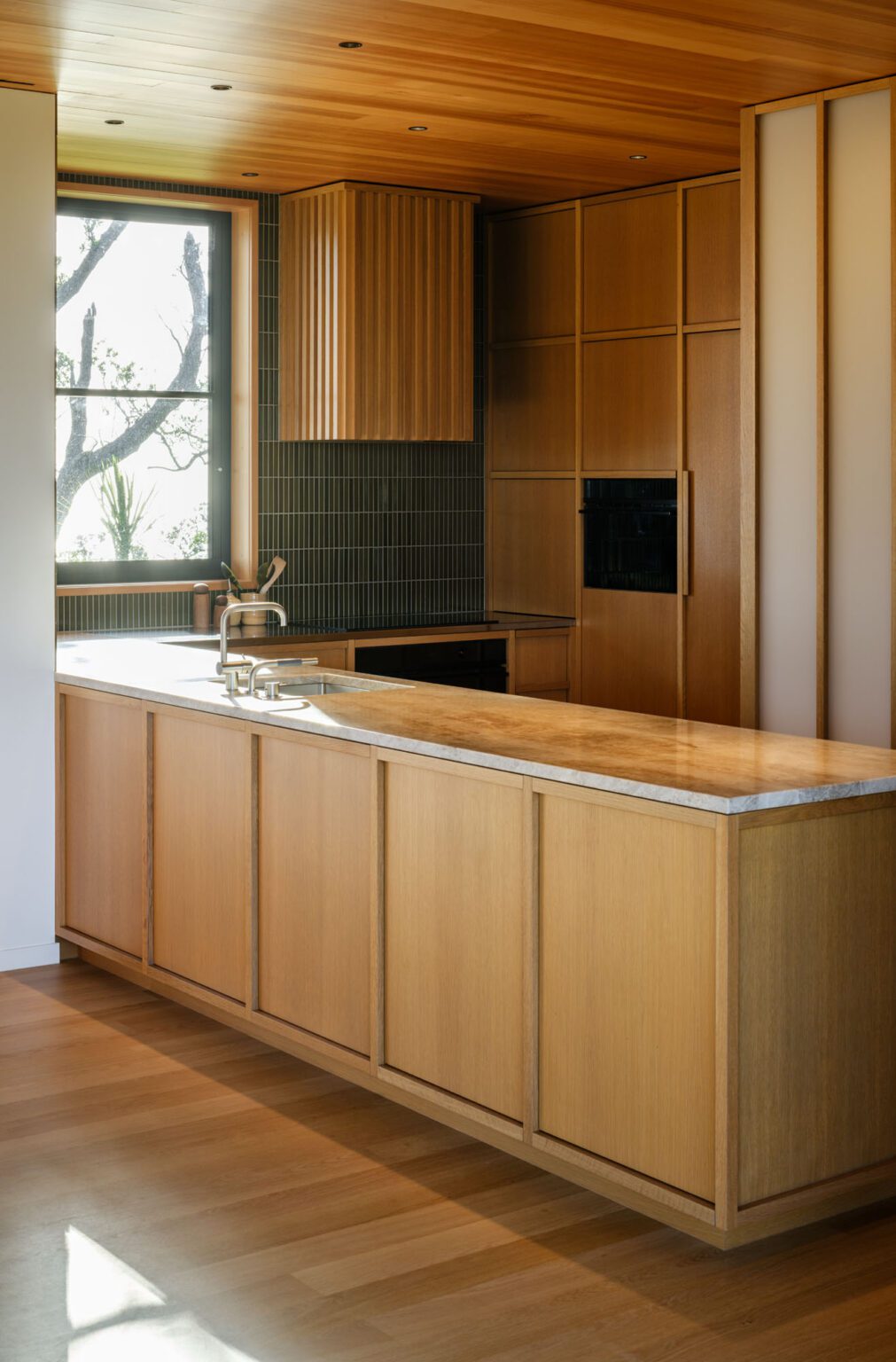
The compact kitchen carries a subtle Japanese spatial sensibility, with timber joinery alluding to shoji screens. The pantry beyond reads as a small enclosed alcove before the openness of the dining space. Warm timber tones and a framed view speak to the Japanese influence threaded quietly through the interior.

Ken comments that art by local Māori “is curved because of the nearby bays and the sand and the wind, where a lot of other iwi’s [art is] geometric. That wasn’t a big driver,” he says, “but it’s kind of fascinating to have that kind of place-based idea.

“The curves give you moments that are really exciting, because you can pop yourself into aspects, and it throws you. It gives you a different relationship to the landscape.

“With architecture, we’re always trying to ennoble the spirit — make your heart skip a beat. [There’s] a device we commonly use — we call it ‘spaces for occasions’. Sometimes you want the higher spaces, sometimes the enclosed spaces, sometimes the spaces that connect completely to the landscape.”

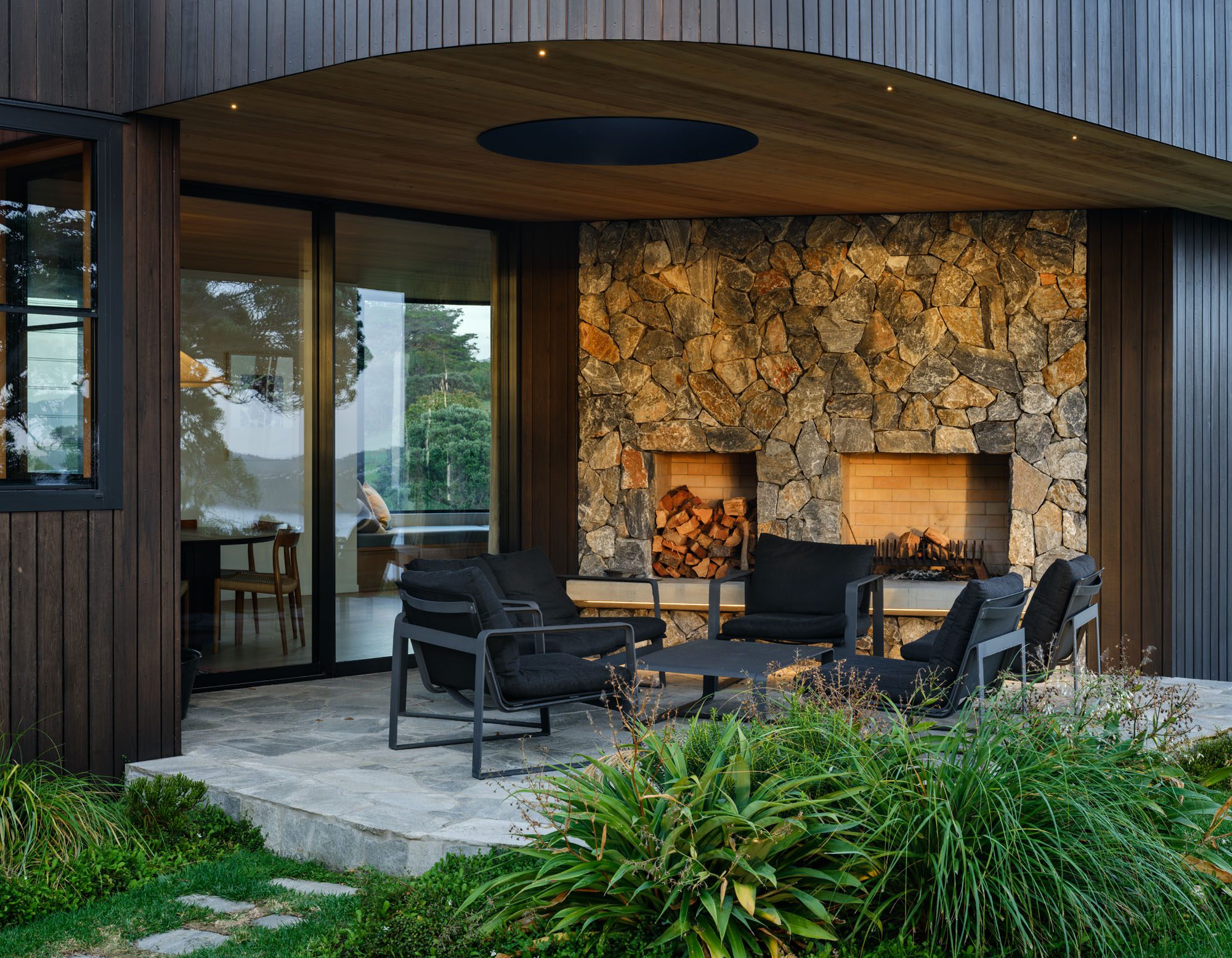
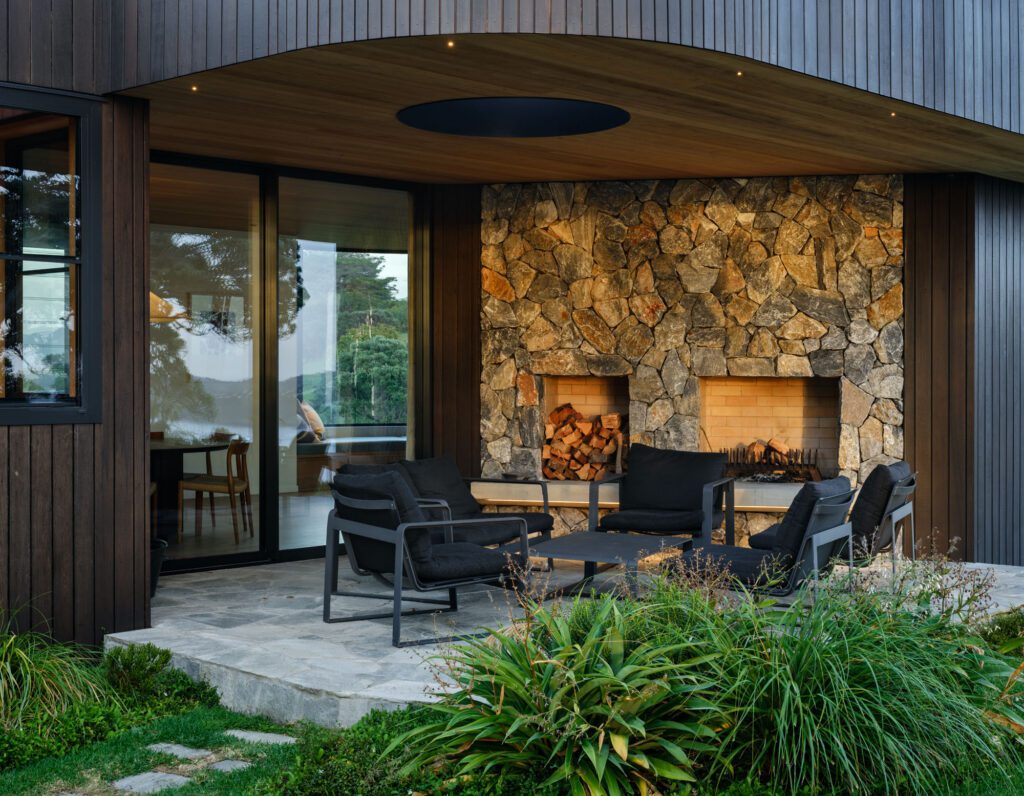
The sheltered south-west terrace with its outdoor fireplace. One of the clients describes it as her favourite place: "Every morning. This is my favourite moment".
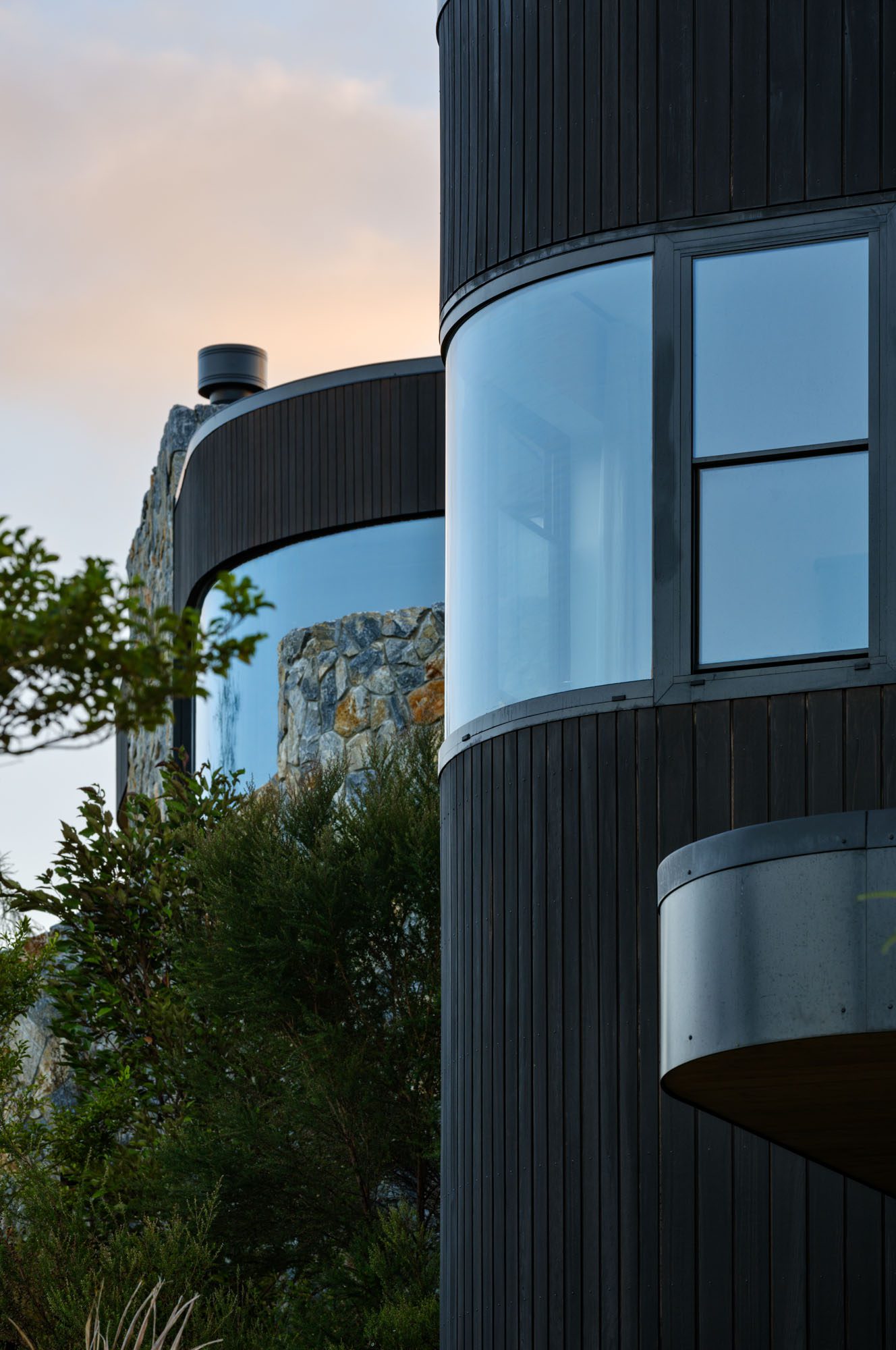
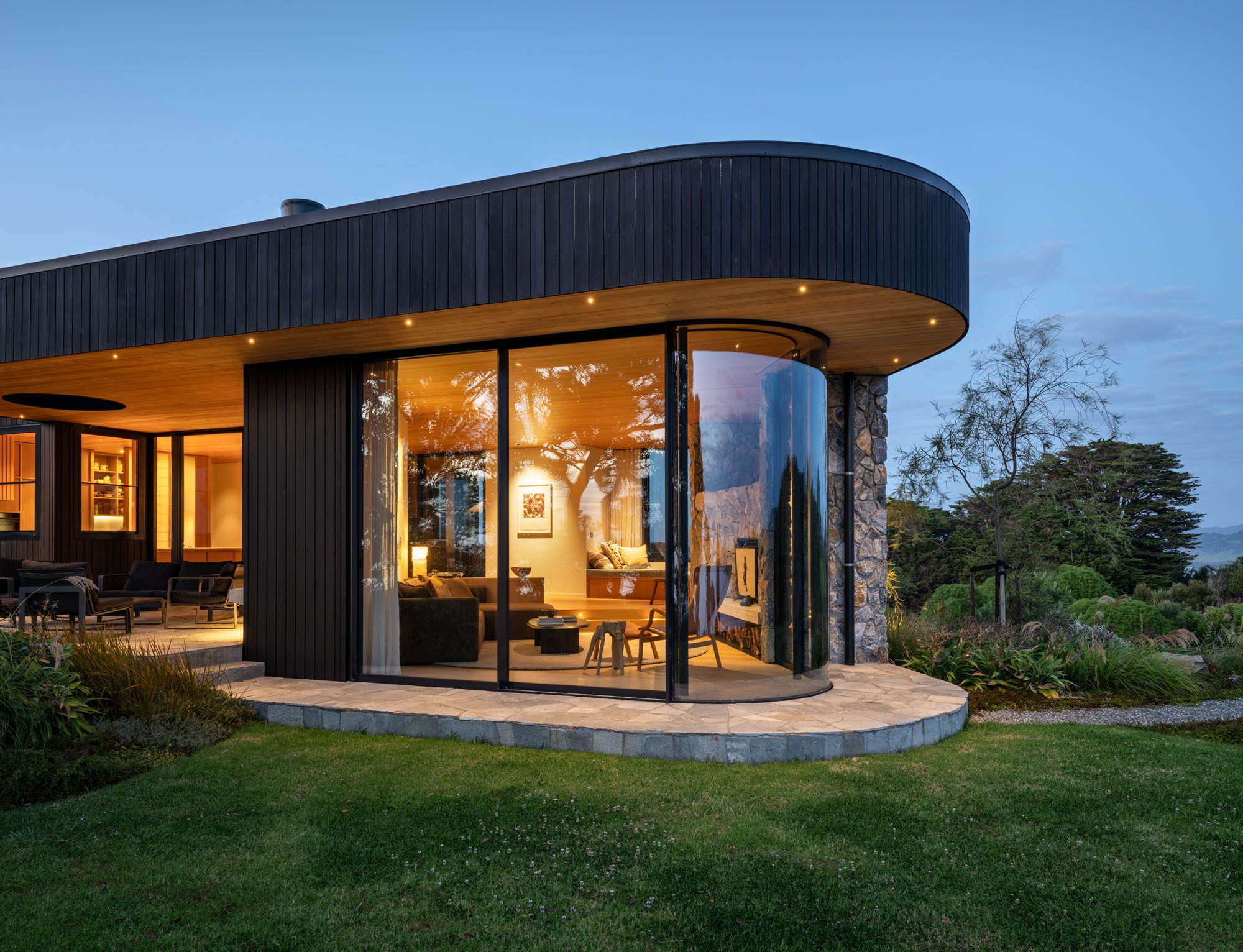
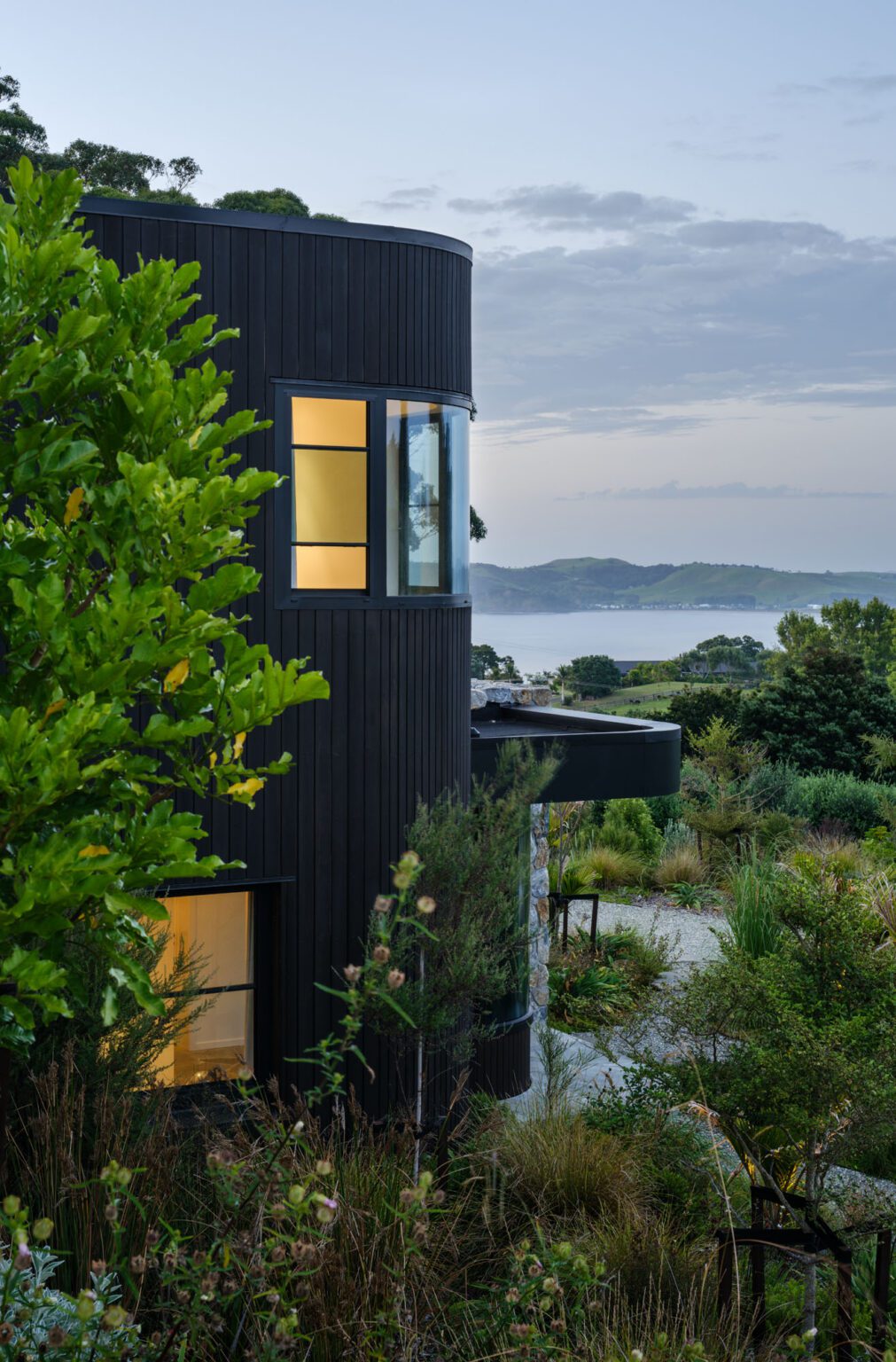
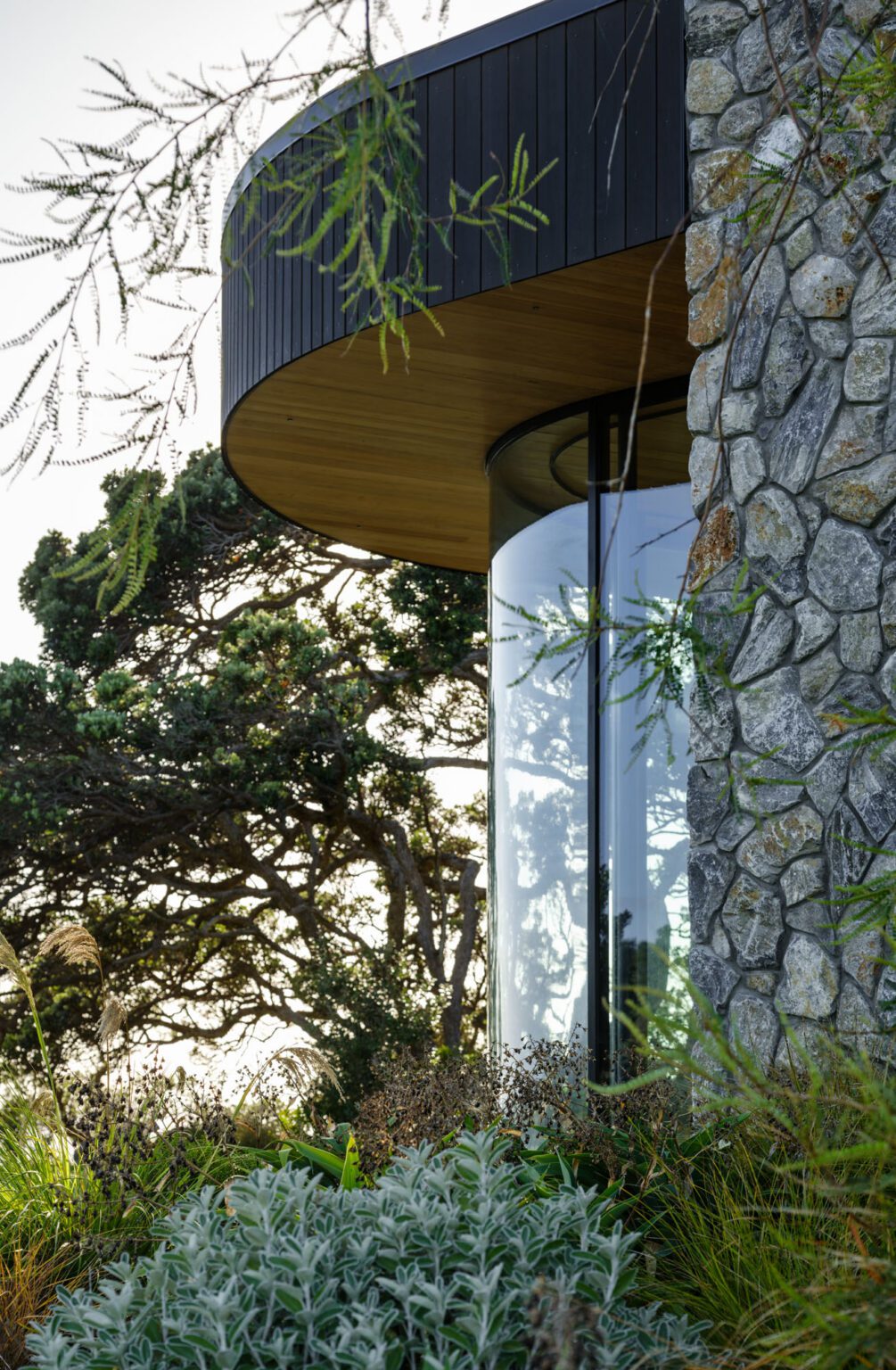
The curved double-glazed bay wraps the corner of the living space, following the roundness of the wall.

The curvature supports this by guiding the body through movement that echoes the natural curves of the land, while landscaping softens the transition between the built and natural environments.

The house is arranged across three storeys: a guest room and garage at ground level, bedrooms for the younger family members on the first floor, and living areas and main bedroom at the top. These are connected by a central staircase conceived as “the big organiser” — a spine that structures movement and spatial experience throughout.

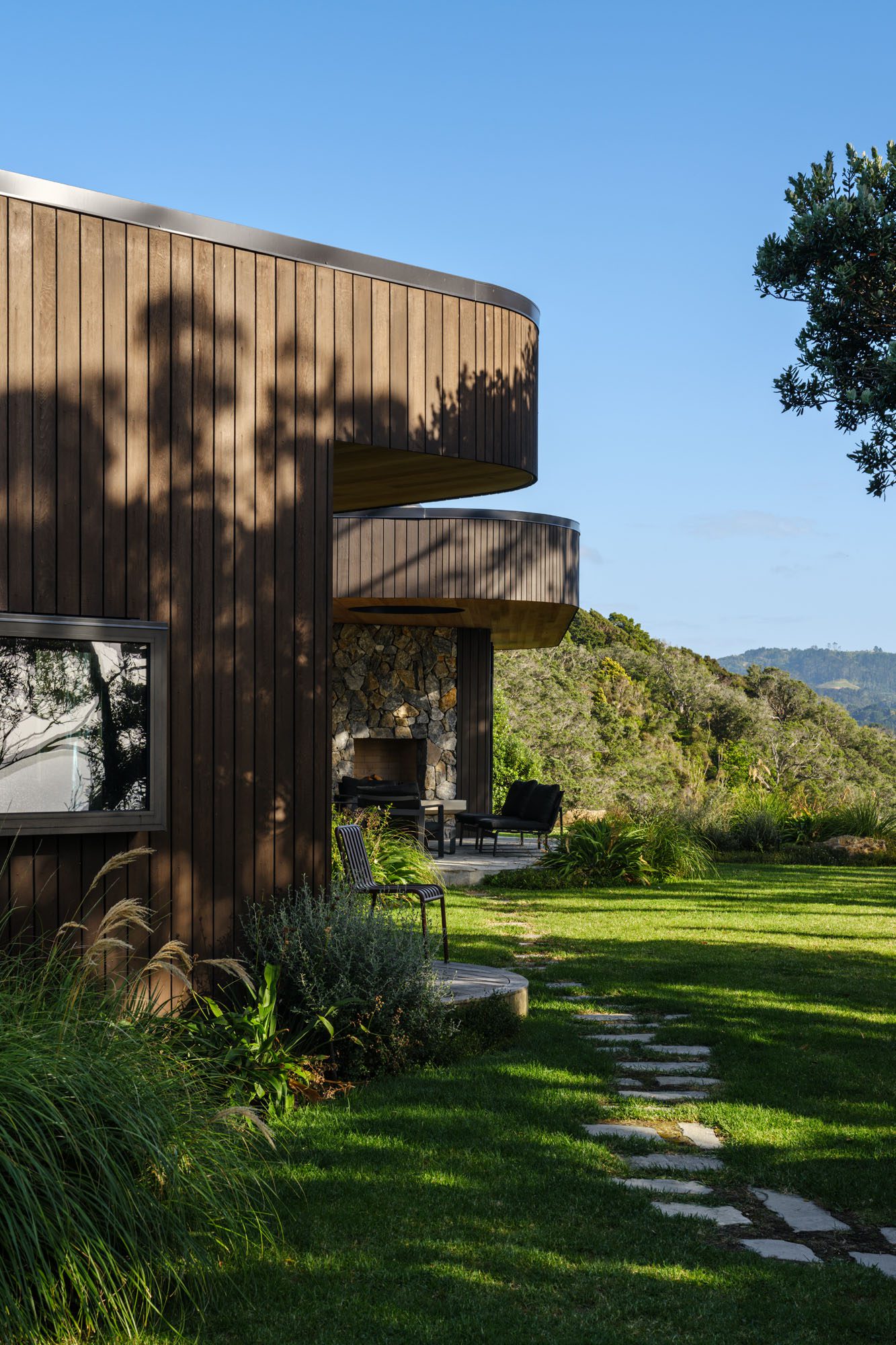
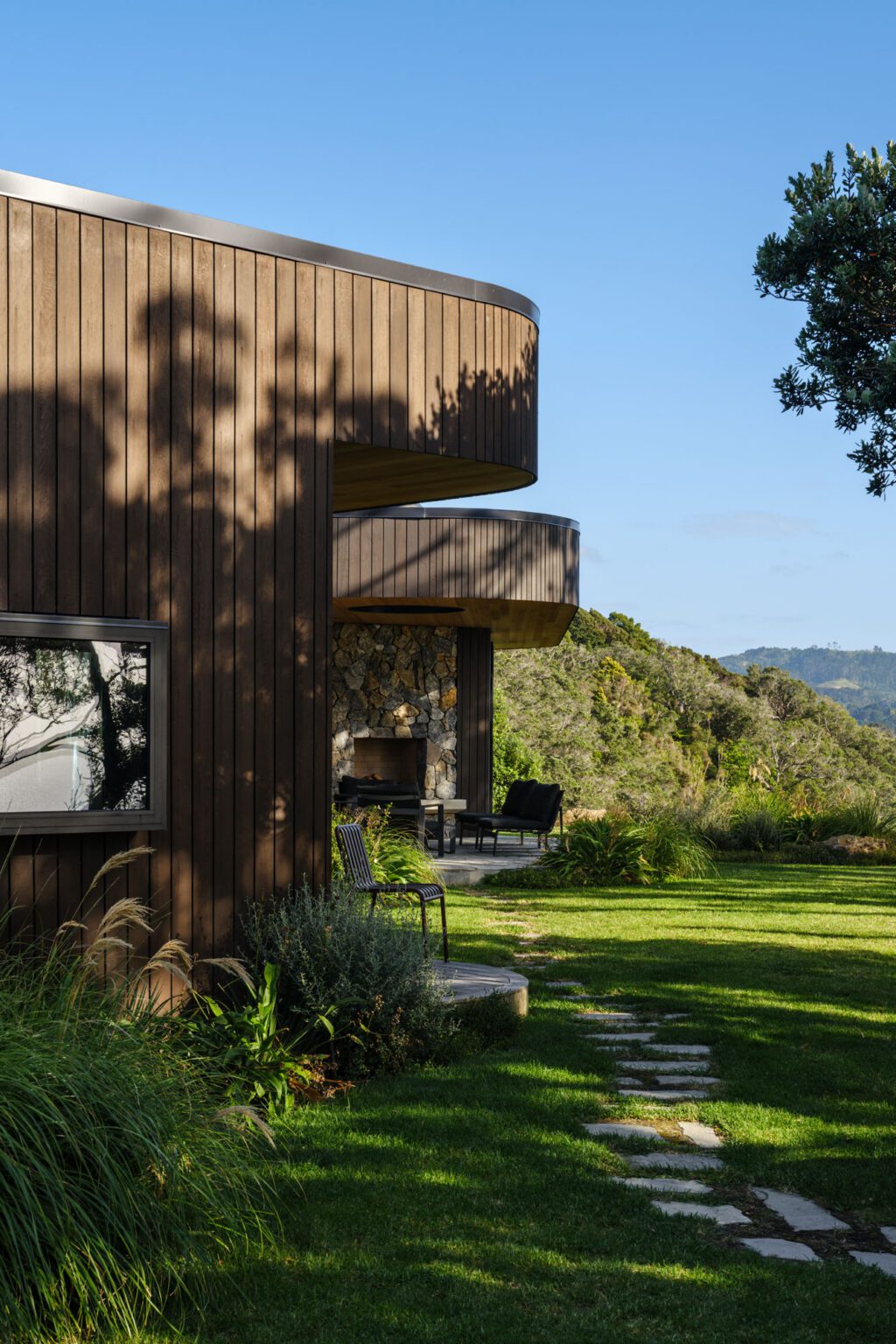
The north-facing elevation, where the two curved cedar wings are most fully expressed. The outdoor terrace at this level connects directly to the view toward the sea.

Circulation along this spine is intentionally compressed and enclosed, with glazed views carefully modulated to offer glimpses rather than full outlooks. As one ascends, the experience gradually opens, the view flowering slowly through successive spaces. The contrast between held-in circulation zones and more expansive destination spaces heightens the sense of progression and spatial release.

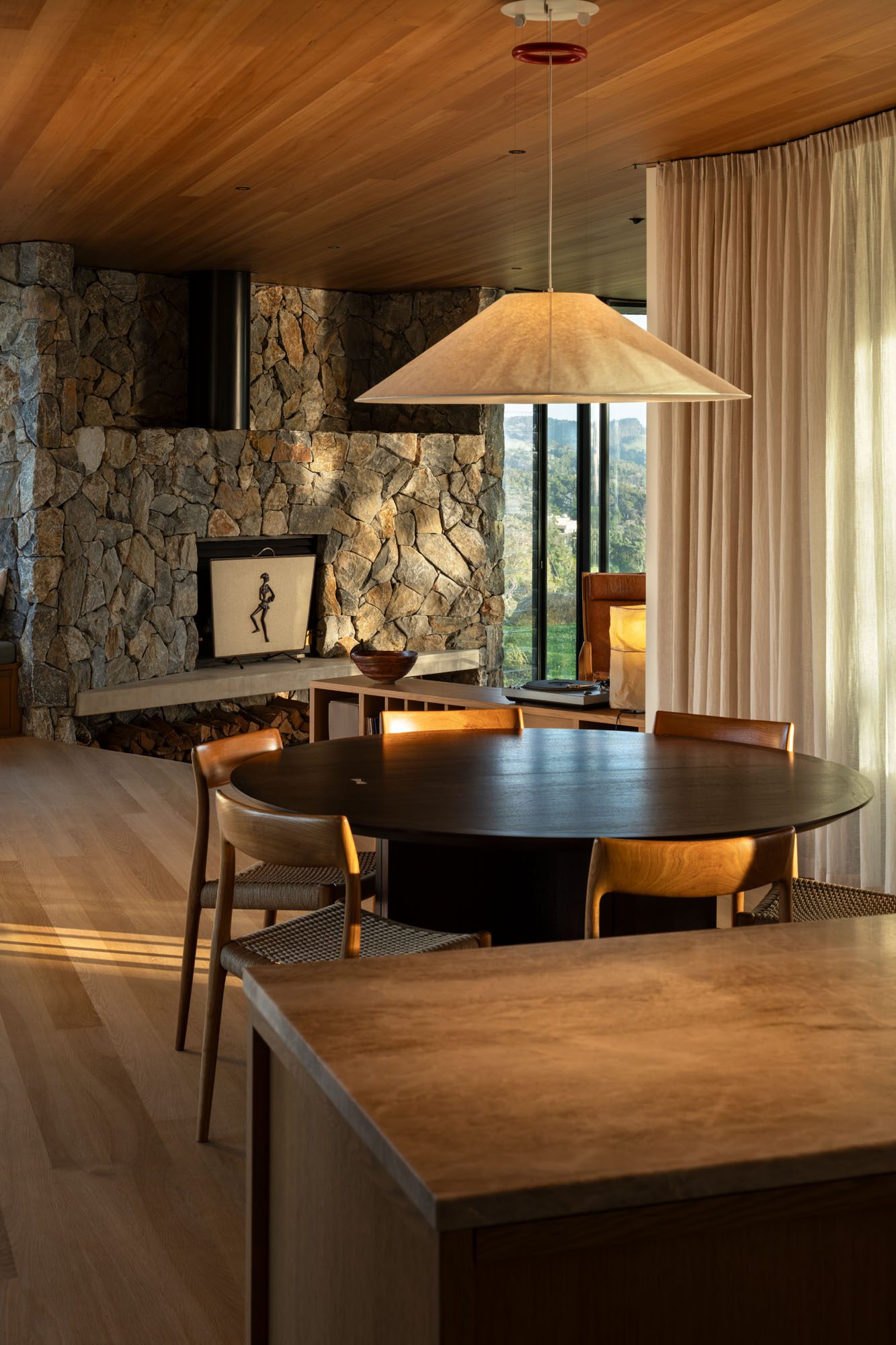
The bedrooms are uncomplicated, but connections to the outdoors make them generous and calm. At the top level, the primary communal areas gather around a large curved glazed bay that creates the most dramatic connection to the landscape. The living room reads as a softened iteration of the exterior materials: stone defining the hearth, dark timbers and curvature lending a hint of nostalgia — something touched by the 1970s, perhaps a little tiki — while the proportions keep it grounded in something contemporary and relaxed.

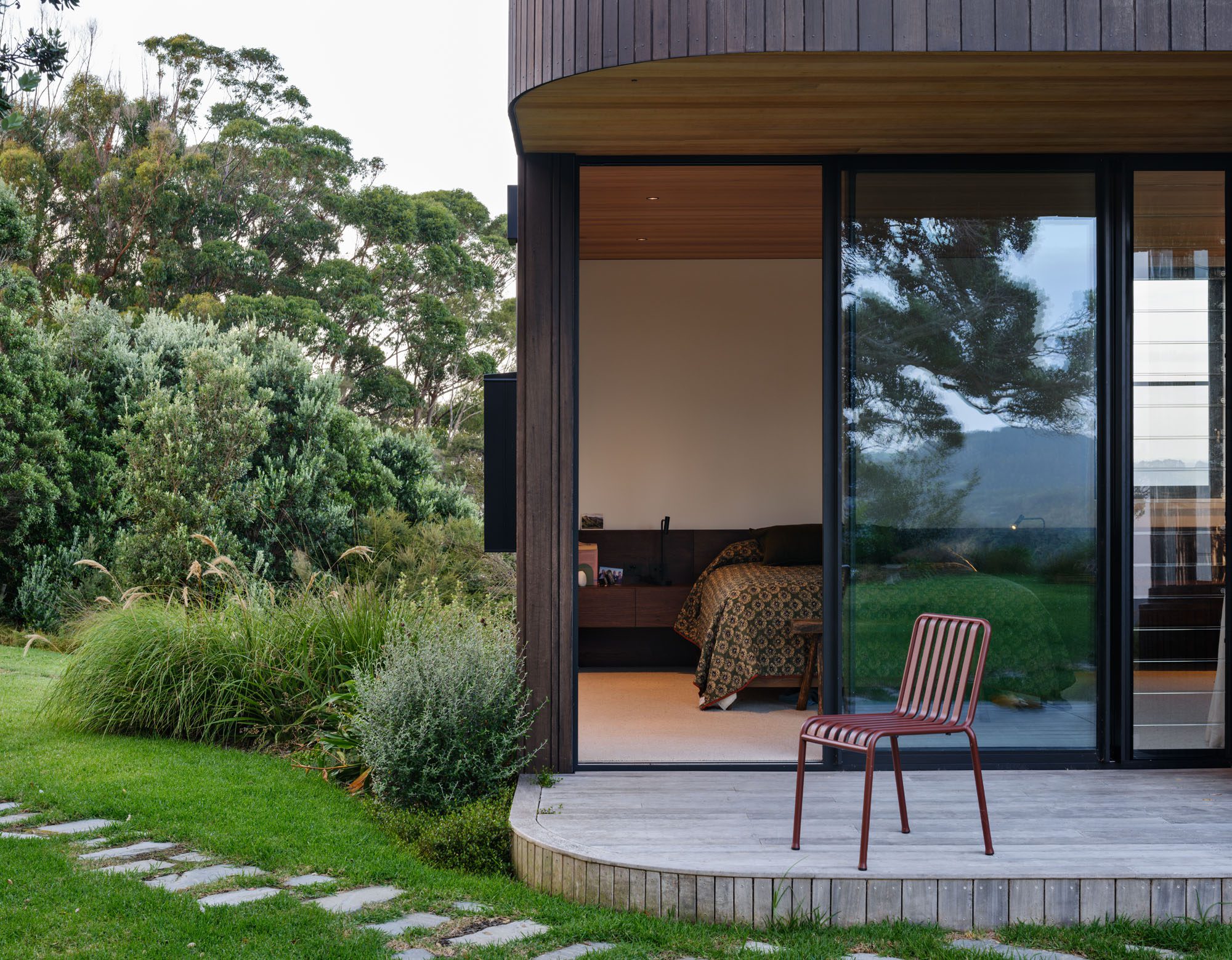
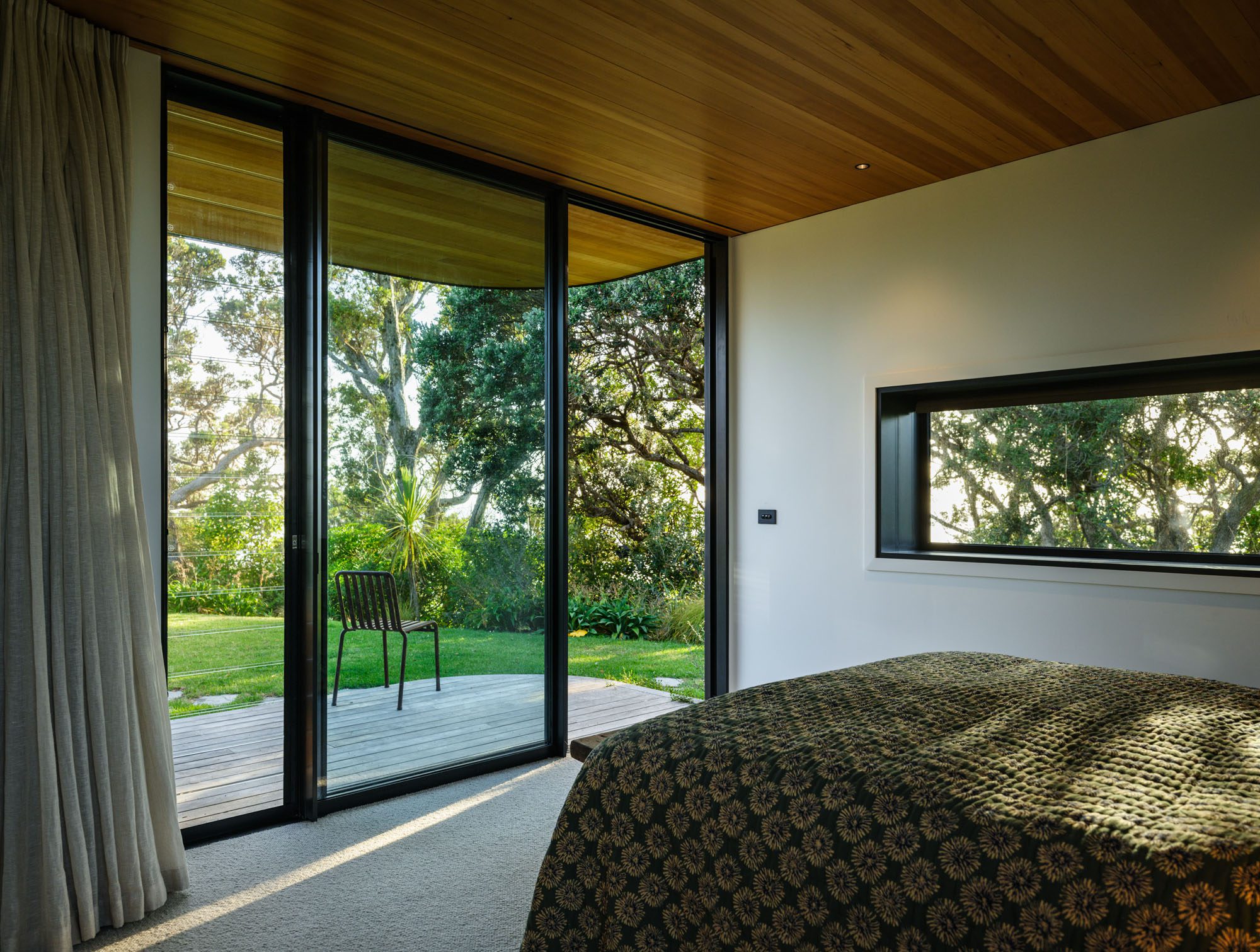
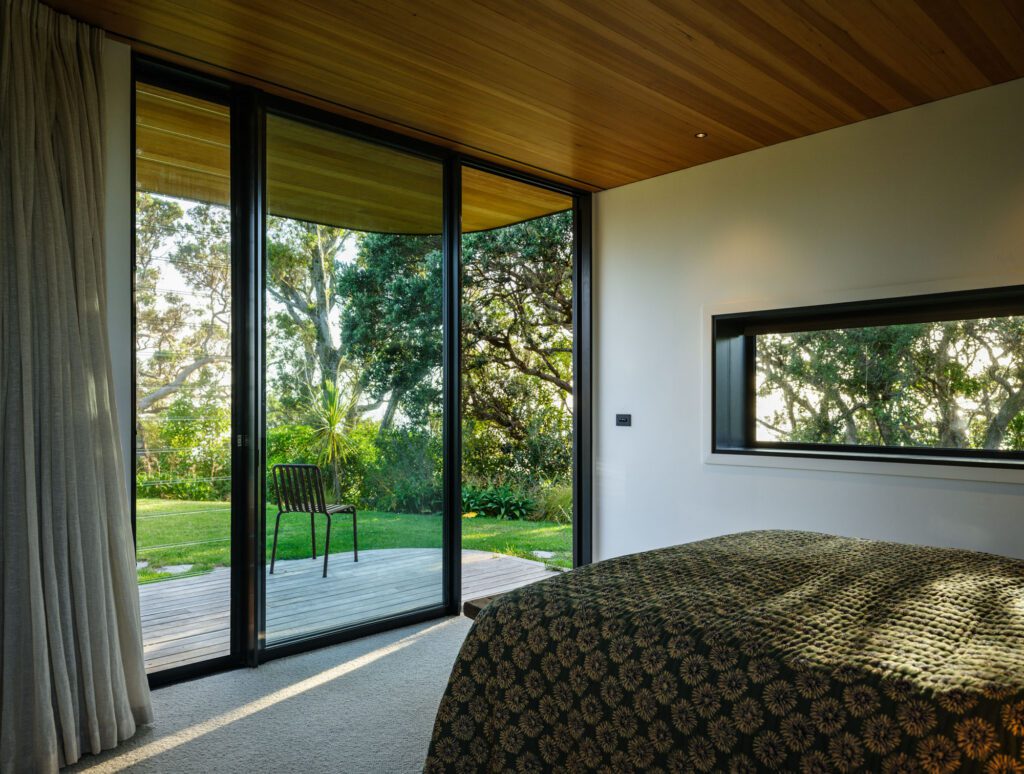
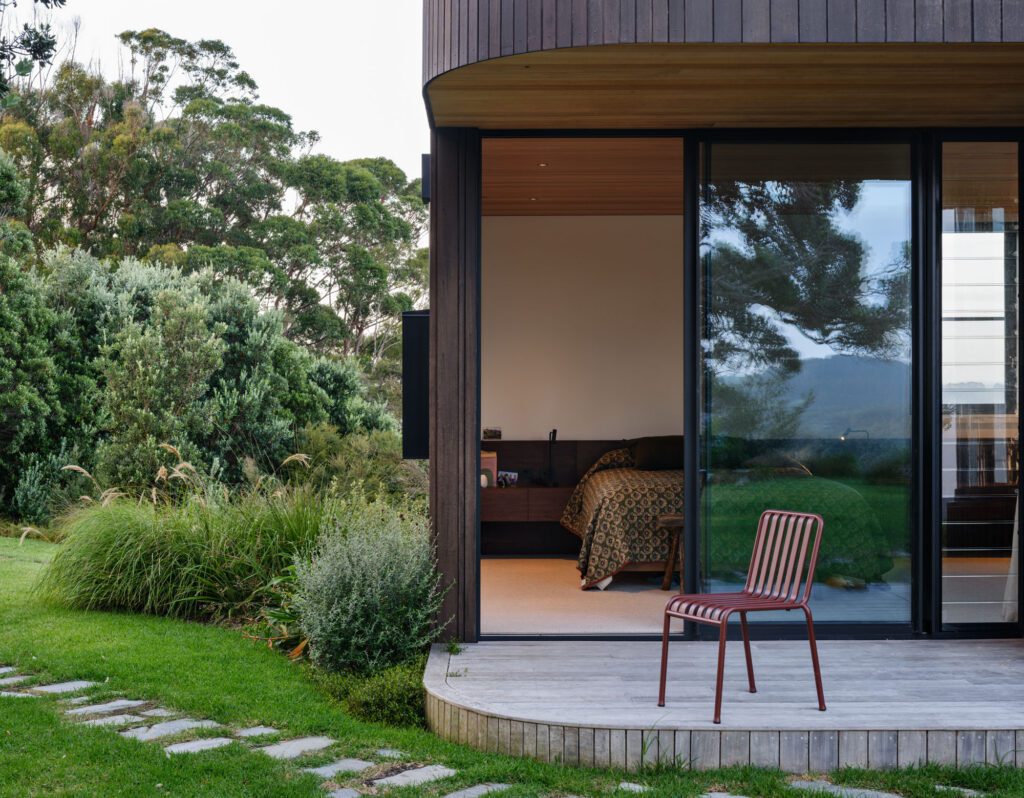
One of the bedrooms opens directly to a private garden terrace. The bedrooms borrow generosity from their immediate connection to the outdoors. The bedspread — a Blooming Flower Block Printed Cotton Quilt by Studio Ford from Handcrafted Modern — echoes the hues of the surrounding trees.
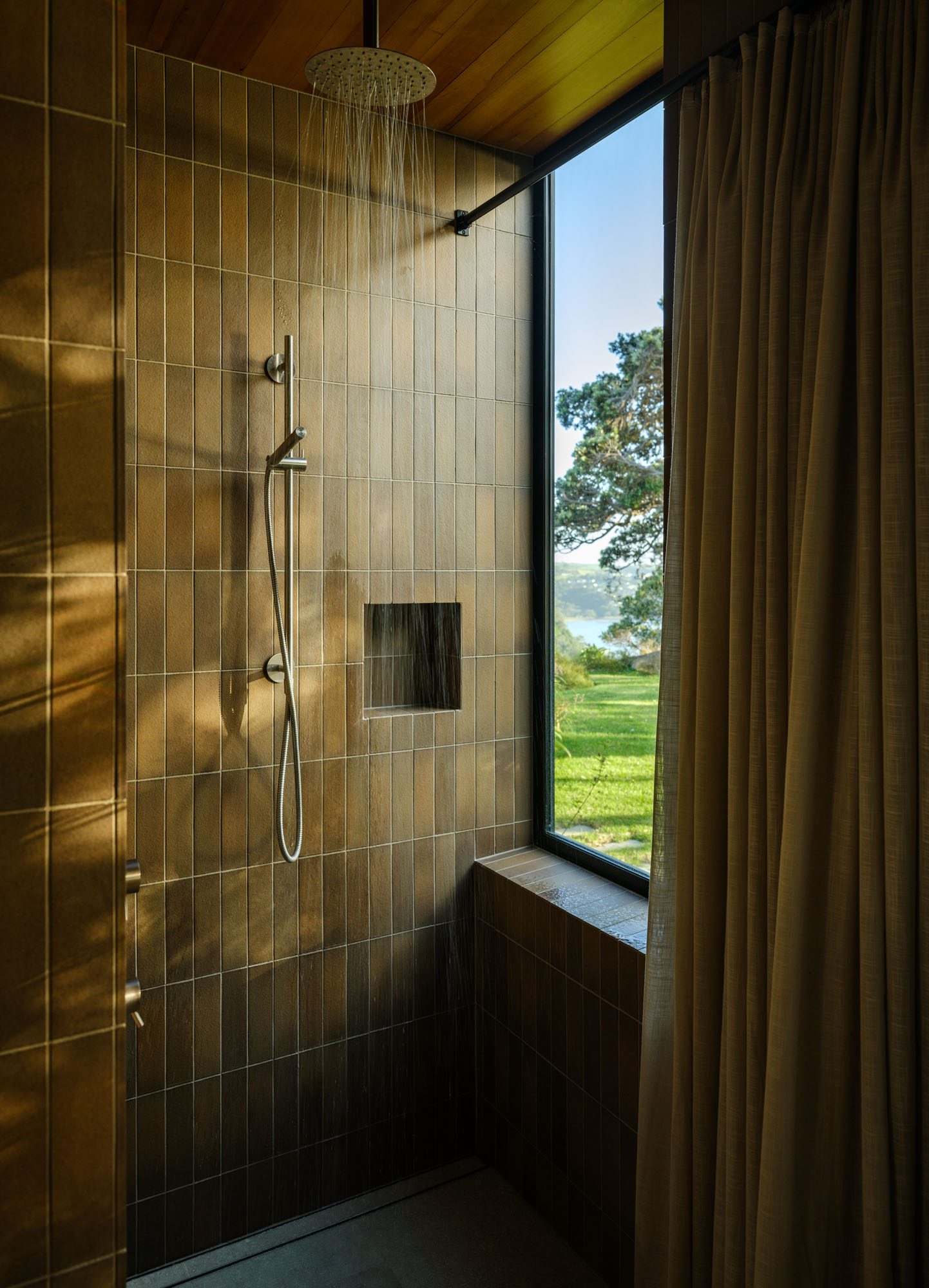
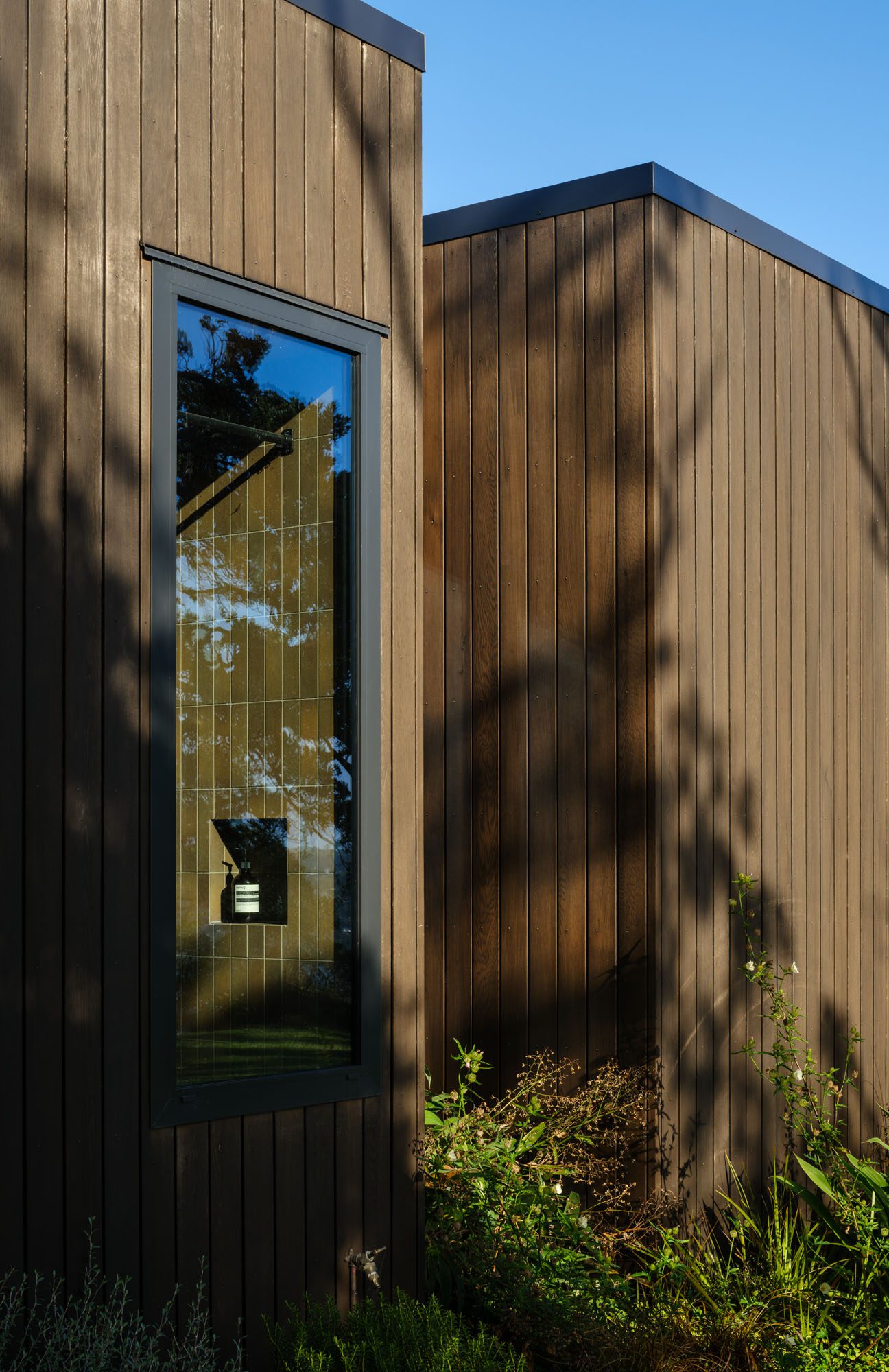
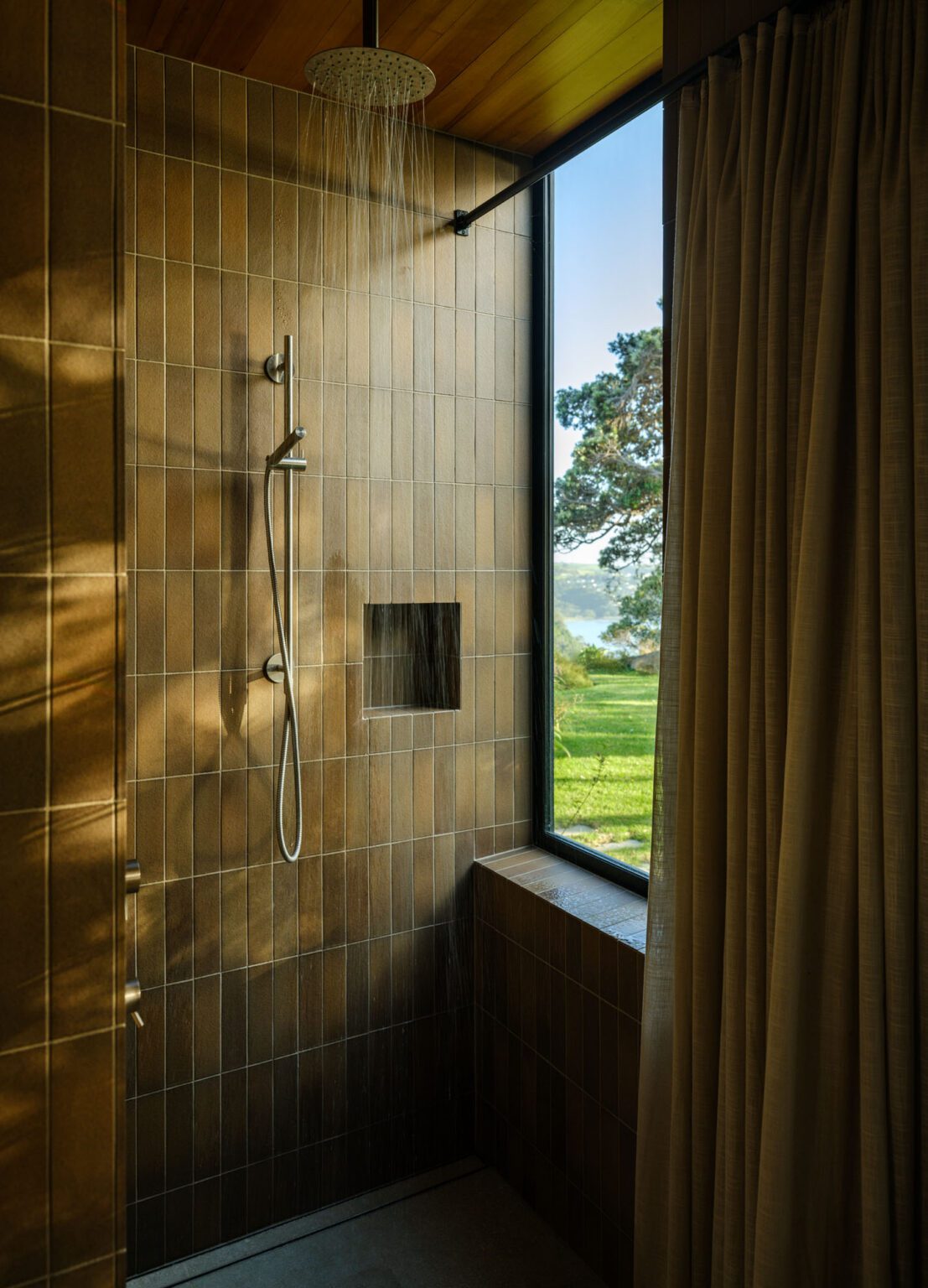
The bathroom is tiled in rich dark tones, selected by the client. A ceiling-mounted shower and a side window drawing light from the landscape give the space a considered simplicity.

The compact kitchen, designed by Crosson Architects, carries a subtle but highly resolved Japanese spatial sensibility, with allusions to shoji screens. It opens towards the dining area and projects outwards to the view. Adjacent, the pantry is conceived as a small enclosed alcove — a moment of compression before the openness of the dining and living spaces beyond. The living area extends to a north-facing outdoor terrace with a fireplace, while a second, more sheltered outdoor space to the south-west incorporates a barbecue, providing flexibility across different weather conditions.

Vertical charred cedar boards follow the geometry of a curved bay. The charring darkens the timber to a tone that absorbs rather than reflects the coastal light.

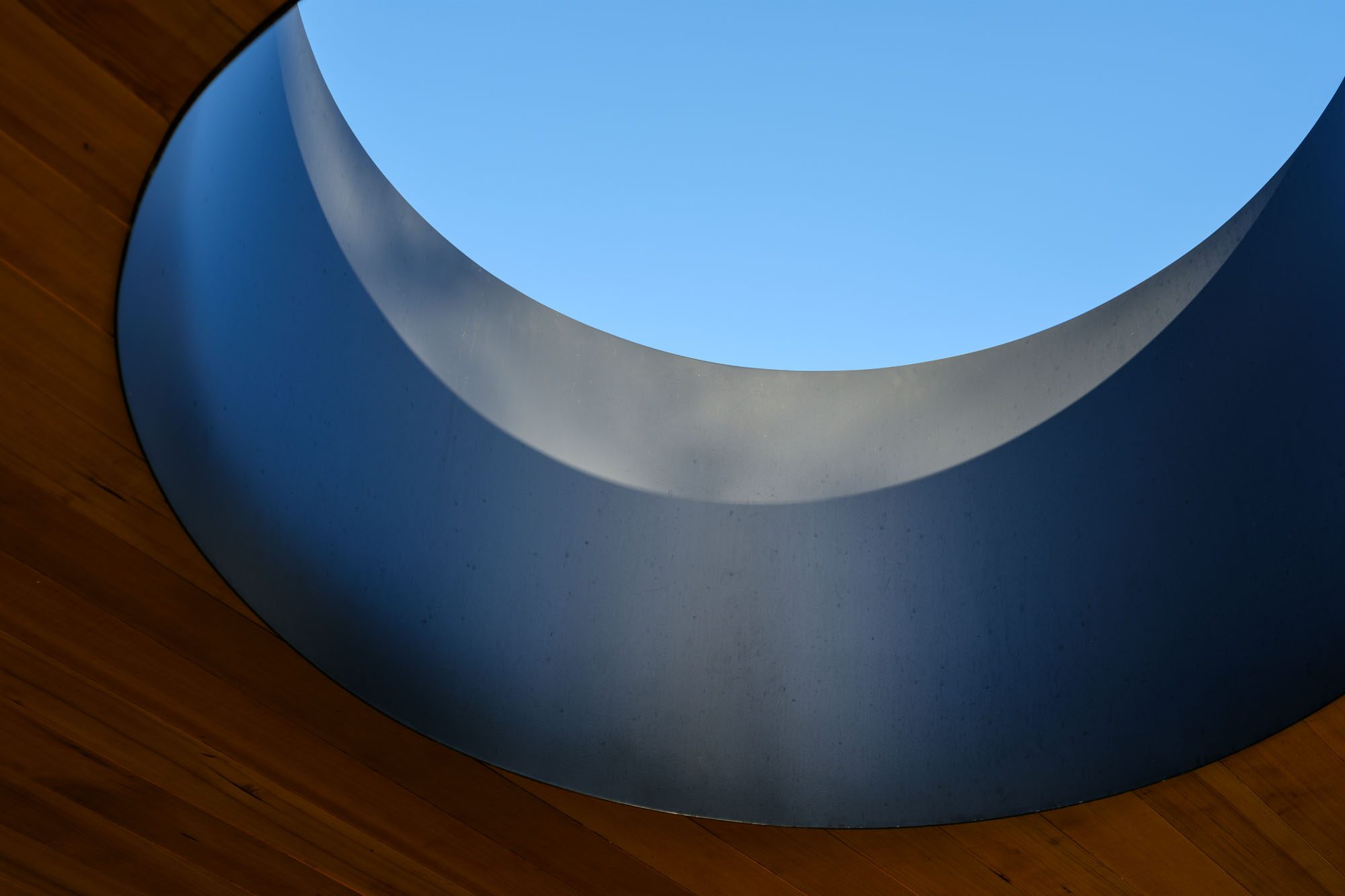
“The oculi are quite important as well,” says Ken of the two large circular skylights. “We wanted that vertical connection — connection to the sky, the stars at night, the elements.”

A fitting send-off, perhaps, into the vastness of the sky, by a home grounded on lava and curvature, geology and light.

Project Credits

Architecture: Crosson Architects
Build: Lindesay Construction
Landscapes: Wraight + Associates and Rochford Landscapes
Words: Federico Monsalve
Images: Simon Devitt

Latest video features

In the Coromandel, a home with a humble profile and a thoughtful design makes the most of a stunning location.

Built with awe-inspiring attention to detail, this Arrowtown home is a fresh interpretation of a familiar Otago rural vernacular.

This sculptural Northland bach is a perfect north arrow on a remote farm high above the sea.

With the sun on its bow and the community at its stern, this is a house in which the elements are always front of mind.

Trending articles

Design News

Ground Control: Peter Fell at M House

At M House by Ponting Fitzgerald Architects, the arrival sequence is deliberate — a slow arc around the building that allows the architecture to be