Bridging architecture and art, Richard Naish’s Transept distils the cruciform geometry of churches into a finely wrought timber object. Shaped through both digital process and handcraft, it explores material provenance, cultural memory and the quiet tension of space between forms.
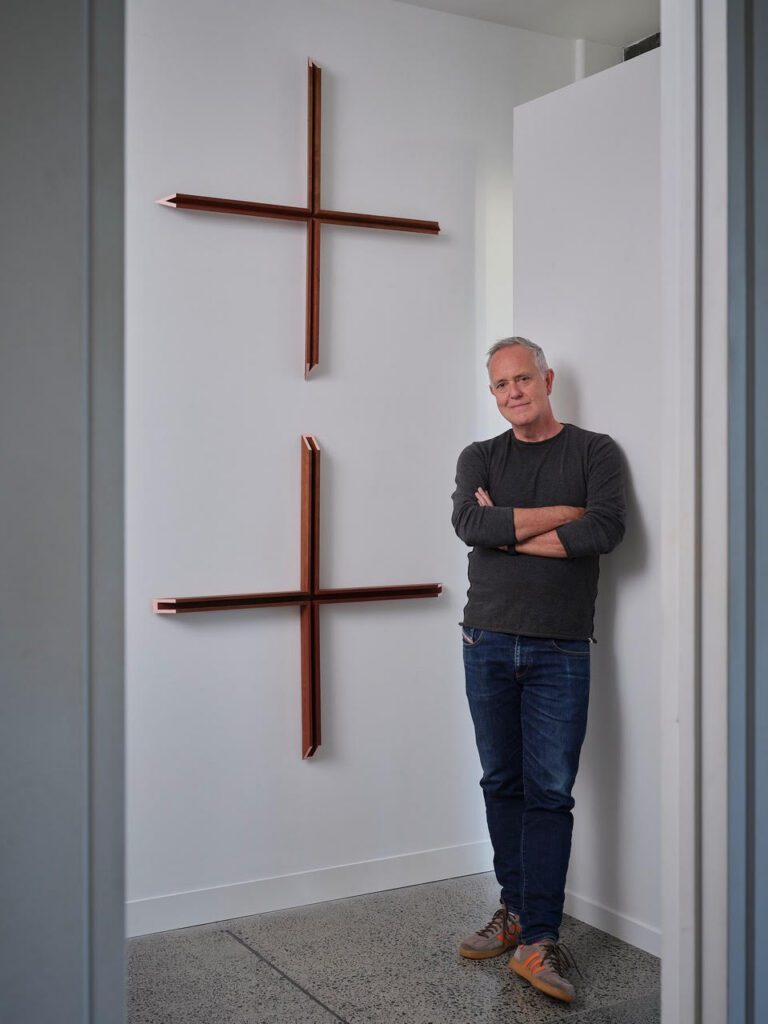
An intersection is a powerful place, a juncture where energies collide. Architect Richard Naish, whose father was an Anglican minister, spent hours as a boy drinking in the hallowed atmosphere and architecture of churches. And one intersection – the representative cruciform design of the transept and nave – has manifested not only in his buildings (the backlit façade of Objectspace springs to mind) but also, now, in an artwork he has crafted for a show entitled Kaba Ko (meaning marvellous things that can be looked upon without limit) at FHE Galleries.
There is no gigantic philosophical leap between considered architecture and art. They both explore a relationship with context and hold embedded meaning. But perhaps in Naish’s case the link is more concrete: his journey to artist has involved the physical act of making 3D objects. “As a young graduate, I was interested in woodworking,” he explains. “Among other things, I made a bizarre coffee table as a wedding gift for my brother.”
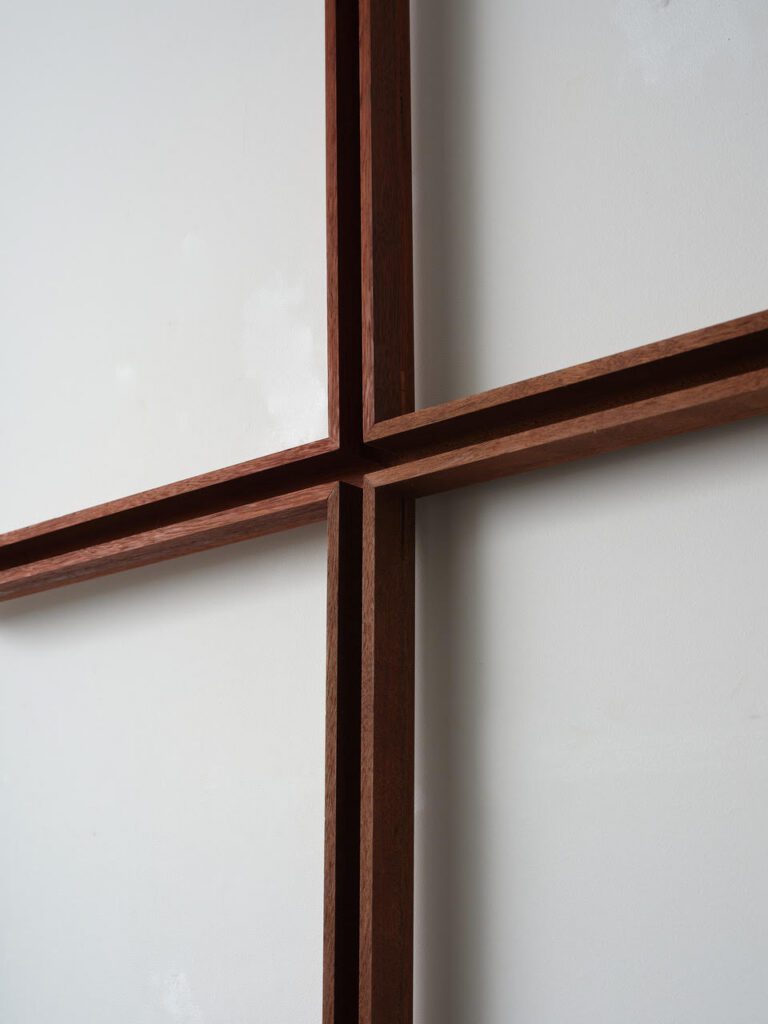
Five years ago, the urge to rekindle these skills saw him enrol in a community course. Then he cleaned out the garage, bought some serious kit, invested in the smaller, defter tools for fine woodworking and began to explore. His first show, entitled Almost, presented a series of experimental furniture (familiar but not quite functional). This latest work moves beyond that.
Gallery director Kathlene Fogarty will tell you that Transept has a compelling quality. She calls it ‘the haunting’ – a piece that silences you for a moment and draws you back for a second look. Made of Australian jarrah sourced from a farm in the Catlins, the wall-hung work comprises a quartet of hollowed-out crosses. For Naish, the material provenance looms large. “First Nations Australians believe that their whakapapa is manifested forever in every living thing and inanimate object – from the land to animals, trees and plants,” he explains. So, the seasoned jarrah, which a client gifted him following the demolition of a stockyard, is imbued with history not only from the 50 years it spent penning livestock, but further and broader, to the ‘everywhen’, a term coined by anthropologist William Stanner.
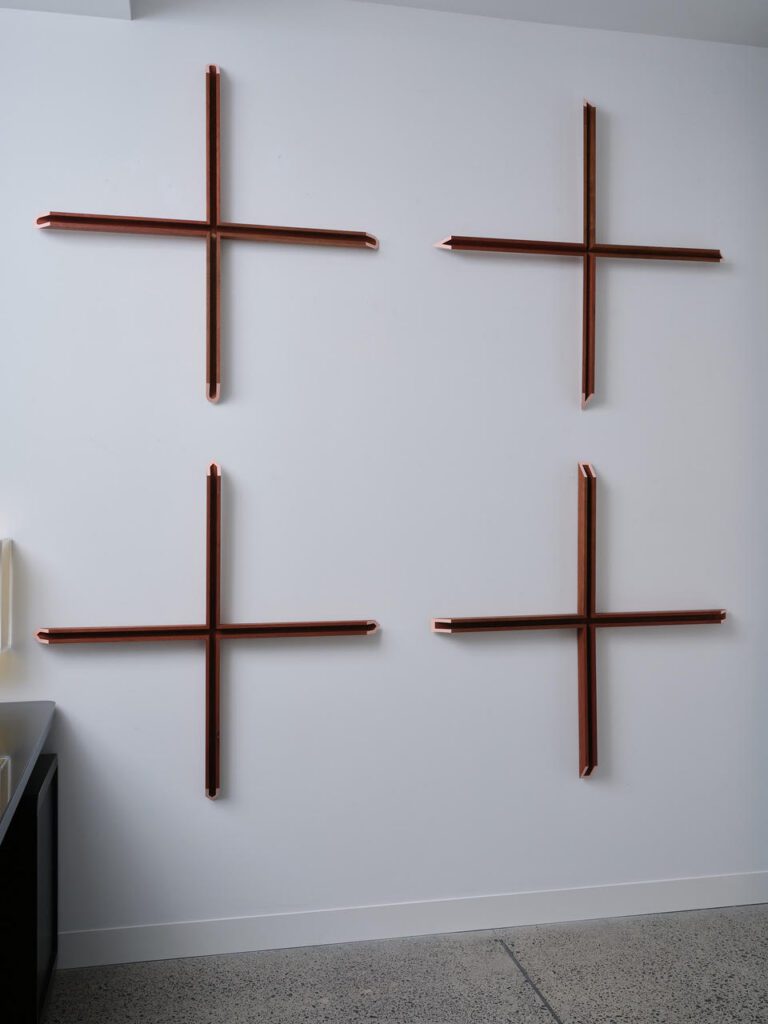
While Naish acknowledges the cross motif as symbolic metaphor, with its multitude of meanings both destructive and progressive, and the heavyweight baggage of colonialist expansionism, underlying this form is, again, architecture. “The intersection of the axes in cathedrals and Christian churches drove the shape,” he explains.
Another intersection: that between digital and analogue. While Naish conceived and modelled the crosses in 3D software, then CNC-milled the jarrah planks, filleting the pieces together was done by hand. It took precision and patience to splice them with L-shaped joints, before they were mitred and glued.
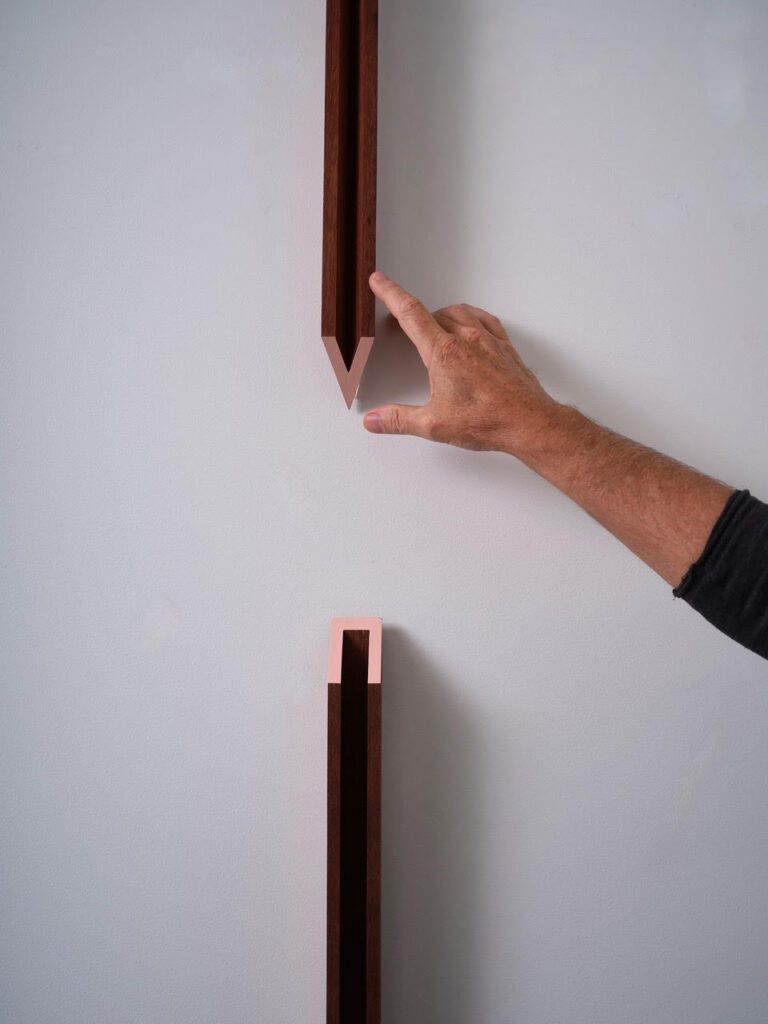
Look closely and you’ll notice another hand-applied feature. A cross-section at the extremity of each arm is painted pale pink. In pre-1900s draughting, often done on parchment or linen in ink or watercolour washes, protocols included a code language of colour, where pink indicated a cut-through of a timber section. In Transept, these cross-sections are also shaped like four roof forms found in churches: gable, vaulted, flat and A-frame.
Displayed together, with points almost touching, another architectural concept is made manifest: the spaces in between become as important as the crosses themselves. “There is a tension between the forms that also sets up a window-like frame. It was an idea explored by artists such as Gottfried Lindauer and Ralph Hotere. But in this case, there’s nothing inside the frame.”
Fogarty is happy to welcome Naish to her small fold of artists, describing his ‘language’ as a visual soul line that can transport the viewer on many voyages. Parallels between his practices of architecture and art are not hard to find. Each feeds the other. “Art reminds me what pure architecture is about,” says Naish. “It should be a combination of the rational, appropriate and the poetic. The skill is in delivering the poetry.”
See Kaba Ko at FHE Galleries, 221, Ponsonby Road, Auckland, from mid-May 2026.